Showing posts with label Research. Show all posts

Wednesday, January 25, 2012

Apply for TEDxWaterloo 2012 - Check!

I just applied to TEDxWaterloo, a local affiliate of TED talks that presents speakers from a variety of different disciplines and backgrounds, revealing a new perspective, an adventure, an innovation, an inspiration! In the application, they asked about current involvement in the community and why I wanted to attend TEDx and I ended up writing about the podcast and my research, so I thought it would be fitting to repost that here. I often write about the difficulties and proceedings of creating a podcast and conducting the research that I sometimes forget to write about how much I enjoy it. I do enjoy it!
I'm a Knowledge Integration student which means that my life consists of jumping between disciplines, trying to come up with new ideas with a bunch of different people, and mostly studying hard, learning hard, and playing hard. I am also an advocate for northern research, being a northern researcher myself - I just got my first publication for my work on arctic ponds, wuhoo!!! Being an advocate means promoting research in the arctic and subarctic, so I am creating an audio podcast - Quirk and Quarks-esque or RadioLab-esque - to tell the world about the amazing research going on at the Churchill Northern Studies Centre near Churchill, Manitoba which showcases the noticeable effects of climate change on all sorts of organisms, from migratory birds to invertebrates! Only in northern research can we say, yea, look, climate change IS happening and it is truly harming northern-adapted organisms. The research I'm promoting is also unique because it is student run, either by grad students working on the edge of existing knowledge of the species or high school students getting their feet wet for the first time while working on long term monitoring projects. This is important stuff, and important to continue studying, which is why I'm a northern research advocate!

The rest of the time (when I'm not playing in water and sediment or interviewing and editing for the podcast) I am busy trying to get the most out of my undergraduate education - so much to learn, so little time! And the best part about learning is that it can occur in any context, it doesn't have to be from a textbook or a professor's lecture, it can be impromptu discussion in a coffee shop, an observation of changing seasons on a walk, or during the mingling of strangers after hearing an inspirational speech on the transformations of jazz or the power of light to create innovating technology at an event such as, dare I say it, TEDxWaterloo!! I live for these interactions with strangers from different backgrounds, whose biases colour their lens of the world and when placed in discussion with people with different biases allows everyone to see the whole spectrum of illumination. It is my fourth and final year at UWaterloo, after which I will enter into the "real world" and have to grow up and I want to be reminded that growing up doesn't mean conforming, it means continually learning, pushing the boundaries and fighting for what you believe in. I want to be inspired.
Apply to TEDxWaterloo for March 21 - deadline is Jan 27 so hurry up! - And I hope to see you there!

Sunday, August 21, 2011

Day 82: Last sampling day

Today was the last lake sampling day, the summer is coming to an end. Figuratively for me, days counting down, but also literally as autumn begins to take over the tundra. The dryas leaves are starting to change to yellow. The berries are all ripe, mostly eaten. The weather is cooling back down to the single digits. The rain has come back with a cold wind but warm sun. Summer is ending and fall is coming to the tundra.

And yet this last sampling day is still full of surprises as Twin Lakes Road always seems to be. Remember the last few times down Twin Lakes Road? The caribou, the two fox, the Wolf!! Today's surprise was a little different...

Giant polar bear poop! With Carley's hands for perspective.
We found polar bear poop! It really is more exciting than it seems at first. Poop has so many treasures in it for a wildlife biologist - learn about diet, parasites, general health of the animal... So, that's what we looked at! First thing to notice is the size. This is a huge bear poop! Huge! Second thing to notice is that it is full of berries. And mostly undigested berries. I didn't know that polar bears eat berries. I always thought that polar bears were mostly carnivorous. I know that they are opportunistic eaters, from the eaten seats off of the quads and snow mobiles, in fact any oil product left outside is potential food. I thought that was a reflection of their typical diet of seals, so seal oil and blubber and fat are all things that are polar bear food. Other bears eat berries, I've seen black bears eat them. But I never thought that polar bears did. And it doesn't seem like the polar bears get much nutrients from eating them either. So why do they?

The second surprise of the last sampling was also polar bear related. The third last pond that we sample was on the coast. As we were approaching the lake, a mother bear was striding along the opposite coast with a cub in tow. They were far enough to finish our sampling, but close enough to not stick around. But the cub was adorable. It was tiny! Probably only a year old. It was amazing! A bit scary, but safely distant.

Wednesday, August 17, 2011

Day 78: Costs

The last insect transect. This is the story of the last morning that I had to be out the door, jars and gun in hand to collect insects from 5 pitfall traps. It is a sad story. I have already explained on August 11 why I am doing the insect transects for the Godwit team, to gather more data for the mismatch hypothesis. The last godwit chick would have hatched (if the nest wasn't deprecated, predated on) on August 15th. So if it would have hatched successfully, which is somewhat doubtful due to the storms we've just had the last two days and that most of the godwits have already begun to flock, then the collection of insects the last two days would show how much food would be available to these chicks. Not much, as it turns out. Just a few spiders and a few springtails and a few parasitic mites. 

Springtail or Collembola. These can get so abundant during
the season that we don't measure each individual one like
we do for the rest of the insects. We just count how many there
are which can get to several hundreds or even thousands in a
single sample.

The bugs in general have been decreasing in abundance, including the mosquitos. I haven't seen any bulldogs for several weeks and the mosquitos are becoming more an more rare to the point that I haven't seen them the last couple of days. The blackflies are another story. These lovely little things have still managed to maintain large numbers, and surging to higher numbers after the rain we have just received. 

But back to the insect transect. Why is it such a sad story? First, I have to explain something about traps, target species, and nontarget species. Whenever a trap is set up to catch something it is meant to catch a specific animal or plant or fungus or human or what ever it is you are trying to catch, your target species. So you use the right bait, peanut butter of a mouse or a homemade apple pie for a human. You use the right scale of trap, decide on live trap or something that might kill what you are catching, depending on the study. 

For the insect study, the insects are sometimes dead and sometimes alive. I don't like it when they are dead because the information we are gathering doesn't require that they be dead. The length and number could be measured if they were alive as well, though it is difficult to trap insects alive. Though I don't like it when they are dead because it doesn't seem right, I also don't like it when the spiders especially are alive. The spiders tend to cling onto the spoon that I'm trying to fish them out of and then climb swiftly up to my fingers, obviously making me drop the metal and push my chair away from the table. I logically know that they won't harm me, but they still freak me out when they move like that! But that is a bit off topic.

The topic is to explain the tragedy of nontarget species. This is when you catch something you didn't want to catch. So I put a homemade apple pie out and I get a bunch of ants, not what I wanted. But this isn't such a bad thing as an unwanted thing. As far as catching nontarget species, this isn't so bad. The ants get a meal, and I just have to bake a new pie. The worst part of capturing nontarget species is when they die because of the capture.

A researcher up here is trying to capture small rodents to find parasites that can be transferred from the rodents to her study animal, the fox, because the fox eat the rodents. She hasn't caught very many rodents, it is a low year in the cycle of lemmings. However, she has caught a frog and two birds in her trap and only one rodent. Her trap is designed to kill the rodents, so she can study gut parasites. This means that the frog and birds were killed too.

They are so cute too...

So why is my last day doing insects sad, besides killing some insects, which is sad enough? I killed a vole. In the third cup, I found a curled up fur ball. It had drowned in the dilute ethanol. It's the second rodent killed in these cups. The only good thing was that I could give these to the fox researcher. Unfortunately, this death of nontarget species is rather common in capture studies. It's always a balance between the benefits of the study and the negative side effects. Is there enough of a benefit? How can you measure it?

Thursday, August 11, 2011

Day 72

To start out, I thought I ought to provide a few visuals to accompany yesterday's post, so the next few photos are from the insect transects that I walk at 7:30 every morning. This morning was a particularly cloudy day that started out rather foggy. The location of the transects is down a bit of a hill from the centre and then into this tundra area surrounded by forest and willow stands. On the best of days, I carry a firearm and a radio, though it isn't very far from the centre, I am going alone. I'm glad that I am cautious this way because later in the day yesterday, I had found out that a bear was spotted right in the area I was walking alone just a few minutes after I had returned to the centre. That worried me a bit this morning, that and the fact of the fog, so I drove the distance down the hill and to the tundra field so the safety of a truck was just that much closer. The distance isn't insignificant from the Centre to the transect, at least a good 2 or so minutes of walking, the length of a song, if I can measure by converting any unit relatively. Anyway, I took the truck this morning, with no incidents or encounters.

This is the marker for the start of the transect. I've always wondered
what it was, as had Hope who had shown me the site and what to
do before she and the rest of the Godwit team had left. I asked LeeAnn
and found out that this is the thing that people climb up onto to get
into a tundra buggy in the winter. The tundra buggies are just that big.
So incase you were wondering.

The first cup. As you can see, the brim is level with the ground
so insects walking along will fall into it. The flagging tape
just helps me see it from far away. It's a big transect and I could
easily get lost on the tundra looking for these little cups.

This cup had a spider at the bottom of the ethanol which I
scooped out and into a jar to measure the length of back in
the lab.

The next adventure of the morning was to go to my five lakes, collect water samples, and take some measurements of water chemistry (water temperature, conductivity - kinda like saltiness, % dissolved oxygen, and pH). At one of the lakes, Larch, there was this huge area of tundra covered in cloud berries! They were the perfect soft ripeness that just falls into you hand just by brushing the top of the berry, so naturally, Caleigh and I harvested a couple bags full!

They taste a bit like baked apple, which is a really interesting
taste for a berry... The blueberries are almost ripe. The crowberries
have been ripe, but they are really hard to eat with all the seeds, and
I just don't find all that appealing. The wild strawberries are ripe,
but other animals (researchers) ate them all before I got a chance. I've
managed to steal just a few of the flavorful strawberries. The cranberries
won't be ripe for another three weeks or so, so I will miss them. And
the bear berries are ripe, but I don't think they taste like much either.

We also harvested a bunch of Myrica gale or sweet gale or bog myrtle to make tea. It smells really good so I can't wait until it's dry! Apparently, it also makes for a decent insect repellant, though I have yet to be desperate enough to smear the leaves all over me. I've gotten close at times though!

After our harvesting break, we went to Caleigh's sites to pluck the dryas puffs. Another thing that I talked about in an earlier blog post.


The afternoon was mostly filtering and bruising up my shoulder. Obviously the more interesting story here is the water filter, which I do twice a week, so I will now write several thousand words about triple rinsing, the electric pump, the cellulose-acetate filter, the sulphuric acid... Well, I could, except the interest level may be lost. Instead, I will talk about my bruised shoulder and how it became bruised. Can you guess?

I had bad form. That's right, I went shooting! One of the most important parts of shooting a shotgun is getting the butt of the stock snugly into the "meaty" part of your shoulder. That was were I failed. That and probably not doing the teapot stance, as in "I'm a little teapot, short and stout, here is my handle, here is my spout, when I get all steamed up, hear me shout, tip me over and pour me out." In the stance, you have to lean forward from the hips, kinda like being tipped in the song or like triangle pose in yoga. That way, the recoil takes the force from the lean rather than directly into your shoulder. So, I have a nice big bruise there now! But the upside is, I'm getting a lot better at aim! I got 6 holes through the target (out of 14), which isn't too bad! Definitely an improvement over the last time I shot, which I managed 0. It was a lot of fun to go out on such a beautiful afternoon! I also got to fire a 22 semi-automatic hand gun! I really didn't expect to do that, I though it was just shotgun practice day. A hand gun is so different from a shotgun. The recoil is there, but in comparison, nonexistent. And that was just really really cool. You can just keep pulling the trigger (unlike squeezing the trigger on a shotgun) without having to reload, since it does that automatically (unless it gets jammed, which it did rather often). With a shotgun, you have to pump between shots to load the next slug, assuming you are using a pump-action which is what I use here. So yea, super cool! I kept my target paper for proof!

Wednesday, August 10, 2011

Day 71: Broken into 4

To make up for the short posts of the last couple of days, I am writing 4 parts today.

Part 1: Spiders

My latest assigned task is to run the insect transects left to me by the Godwit crew who left us about a week and a half ago. Before the Godwit crew left, they had been going out each morning to collect insects from these pitfall traps, daily in some places and weekly in others.

Imagine a plastic cup with ethanol about a quarter of the way up. Then imagine digging a hole into the ground so that it perfectly fits this cup, right up to the brim, so the brim is even with the rest of the ground. Then leave the cup there in your imagination. Walk away. Go about whatever the day has in store for you. You can even forget about the cups for the rest of the day, it's ok, because science is still going on. So what is going on? You are going to have to come back to that cup you put in the ground. And when you carefully lift the cup out, there will now be life in it! No, this is not spontaneous generation, which Louis Pasteur disproved with his meat in a flask experiments. So the other explanation, which is obvious and you probably already know, is that life/insects that were walking along, minding their own business, kept walking only to discover that they suddenly fell into a liquid which they cannot escape due to the slippery sides. Some people use a soapy water mixture to break the water tension so the bugs can't escape that way. The Godwit crew used ethanol to preserve the insects that may die between sampling times. So when you sample them, you have to take a spoon and fish out each insect and put it into a different bottle so you can take it back to the lab and identify the insect to order. This is a simplification, it's a bit broader than insects and includes a wide variety of invertebrates, including spiders and snails and flies and ants, but basically small moving things that a Godwit would find tasty. A Godwit, or the more specific species, the Hudsonian Godwit is a football sized shore bird with a long bill and long legs that makes yearly migrations from South America, such as in Argentina, to the arctic, such as Churchill or Alaska. Their population is in a decline, as are many shorebird species, but no one really knows why yet.

So why do they collect these invertebrates? To answer the question of: how much food is available for Godwits and other shorebirds at a given time of the year? This is really important and forms the basis of the Mismatch hypothesis. The mismatch hypothesis has to be explained in three steps. First, normally or in past conditions, the migratory birds go somewhere to breed and time their breeding so that the hatch date of their eggs will be close to, or match, the same day that the invertebrates are at the peak of their abundance. Second, it would be beneficial for the hatch date and the day that food is most available to match up because the chicks born would get a lot of food in the first few days, critical for growth! Third, the hypothesis says that due to climate change and warmer and earlier springs, the invertebrate abundance peak is happening earlier, but that the birds are still migrating at the same time and breeding at the same time so that the hatch day is after the peak invertebrate abundance day, hence a mismatch. If the mismatch continues, the chicks are less likely to get the food they need to grow, and thus be more vulnerable to starvation, predation, sickness, storm events, cold weather, stress, etc. It's not good.

So this is one of my tasks. I have to walk down to the transect near the Met building (meterological building where weather measurements used to be taken back in the army and rocket days), fish the insects out of the cups with a spoon, some alive, some dead, and then take it back to the lab to id them and to measure them. This allows the Godwit researchers to calculate the total biomass at that location, biomass is used as an indicator of how many insects are available for Godwits to eat.

It is not my favorite job. I have so far found 2 frogs, both luckily alive so they were released and allowed to hop away. I have found a female spider with 20 baby spiders dug into her abdomen! They were all alive which made it really stressful trying to count and measure all of them! The spiders creep me out the most. I put a spoon gently and slowly into the bottle to carefully lift a live spider off of the top of the water and it suddenly jumps up and tries to grab the spoon! Of course I drop the spoon. Of course I spill the bottle. Of course the spider starts its frantic skittering to get away. But I recover faster and block it with the ruler, getting a measurement at the same time. Now she can run away as fast as she likes. I got my data.

Part 2: Bannock

Today was quite special today, though. It was a slow science day, mostly playing around with graphs and reading journal articles, so I got to sneak into the kitchen. I made bannock. Bannock is a traditional Scottish dense bread that was brought over with the Europeans. When it was brought over and introduced to the natives, it just took off! It took off so well in the native community that many people misconceive it to be a traditional aboriginal food. The study centre sometimes makes a special dinner for the tourist groups and learning vacations who stay at the centre. During this dinner, they serve arctic char and bannock. I love bannock! It is so delicious. And having not really cooked or baked anything all summer, I was itching to get into the kitchen, and I was itching to learn how to make bannock. Today, I got my wish.

There are so many different recipes to make bannock, each tasting differently from the last, but meeting the same basic principle: dense bread. The recipe that Rob and Rosalind, the chefs at CNSC, use is a Thompson Cree recipe. It is really simple: flour, baking soda, salt, sugar, water, oil, milk. Mix, knead, poke with a fork, let rest, bake, eat. Well, that's how I made this one, with Rob's guidance and flour dusting assistance. There are a lot of varieties on how to cook it. Instead of baking, the dough can be deep-fried and be more of the consistency of a donut (soooo amazingly good!). Or the dough can be wrapped around a stick and roasted over a fire (haven't tried this one yet, but it has become highly recommended). The ingredients can change as well. Instead of oil, blubber and fat from what ever is available can be used. Or raisons can be added. I suppose you can also add whatever spices you want, but I'm not sure it is necessary since the bread is basically just flour, you can eat it with anything, a hearty stew or with butter and honey or jam, or, which I have Krista and Celia to thank for, with cream cheese and pepper. All variations are delicious! I really like bannock. I think I'm going to have to make it when I get home.

Part 3: Skip if you really liked part 2

I gave you the warning to skip this section. I really think you should if thoughts of melted butter on bread and warm campfires are still in your head. Seriously, you will not like this next section. You have been warned.

To those who do not take warnings seriously, this section is about scent. I am not talking about the scent of a flower, or the scent of baked bread, or the scent of perfume. Well, perfume may not be a terrible example if you think of the perfume made from a murdered girl as in Patrick Suskind's Perfume: The story of a murderer. Really, that is the mind set of this section: disgust. Still want to read on?

I returned from baking the bannock back to the lab. As soon as I opened the door, a wall of air hit me, smelling of fermentation. Stepping into the room with a look of disgust openly displayed, I started to distinguish a fruity scent mixed with the fermentation. LeeAnn was there as well and mirrored my face when I complained of the scent. She thought the same, but didn't know what it was. She had left for half an hour or so and came back to the stench in the same way I had. That's when I started sniffing around the lab benches.

I have never really used my nose to locate a specific small location before. We humans are so smell deficient. We are unable to distinguish scents, and can only track them if they are really strong and becomes visual once you get close. Think of a pie. You smell it, you know it's a pie, you walk in the general direct, nose pointed into the wind, and you look until you see a pie. Now think of a rotten fruit, a tiny thing that can be hidden anywhere in this room, and emitting a strong odor. I had such a hard time trying to pinpoint the location of the scent. It is not a sense that I have ever honed, nor needed to hone. And pursuing a stench by following your nose seems to be such an weird thing to do, sniffing avery few feet to catch the direction.

But after a few minutes, I became acclimatized and didn't notice the scent as strongly. I had to leave the room for a bit and come back to try to narrow the space further. Once I got it to a corner of the lab, LeeAnn and I tried our visual cues. Breaking out a flashlight, looking in every box. I thought that perhaps the squirrel had stashed something somewhere, since it's been running through the lab for a couple days. (The squirrel was found dead yesterday in the old gift shop. It had tried to chew through the wall, which probably killed the poor thing. Why didn't you go into our trap? There was cookie in there, waiting for you. Then you would have been released back to the wild!) Then, I thought that someone had tossed something in the corner, since the scent started sometime between 3 and 4:30, and it was suddenly strong! Or maybe a chemical spilled that was causing this weird reaction. Or something like someone putting on hand lotion and walking out - what a terrible scent for hand lotion! We didn't find the source. My hope is that tomorrow it is either gone, or a stronger scent so we can find it more easily. In conclusion, my olfactory senses need work, and I did warn you. No more delicious thoughts in your head.

Part 4: Yoga

I went to yoga in town this evening. It was a class meant to open the hips. There was a lot of forward bending and groin stretching. It was a pretty challenging class tonight. But I am so proud of myself. I have definitely gotten more flexible this summer. I didn't need to use straps for some of the poses today during some of the forward bends, where the hamstrings are stretched out. I could actually wrap my fingers around my toes and touch the flour without props. The next step is to get my head to the floor! For a brief moment of exertion, I decided to push further on the pose where you sit with your legs stretched out in front of you. I managed, for a second or so, to touch my head to my straight knees! I couldn't hold it, but it is definitely proof of having become more flexible.

Yoga normally begins and ends with savasana, corpse pose. You lay on your back with palms up and legs flat and just relax, melting into the floor. Erin, our yoga teacher (teacher is a much better word than instructor, she was doing much more than giving direction to the practice and demoing poses, she was teaching one on one, focusing on each individuals pose and how to improve that person. Erin is an amazing, caring teacher), played a crystal bowl during savasana. The concept is to create a resonance that will amplify the specific frequency of the bowl until the vibrations seem so loud that they are felt inside the body. It is similar to running your finger around the edge of a wine glass to get that deep tone. The physics behind it is all about waves and oscillations. The player adds energy to the system that matches the natural frequency of the bowl, that can lead to the playing of harmonics. It is so perfect when you hear it. The feeling from these bowls is so uplifting after a long yoga session. I was in a state of dazed peace, with such a strong love for everything in the world. Thank you, Erin.

Added tidbit:
I booked my flight back to Waterloo today. I have mixed feelings. Tomorrow means only two weeks left. Last year, I came up here at the start of two weeks and felt like that was such a long time. Right now, two weeks seems like a blink of an eye, so I don't want to blink.

Monday, August 8, 2011

Day 69: Once in a lifetime

Last night, the Aurora Borealis:


Over a setting sun at 23:45


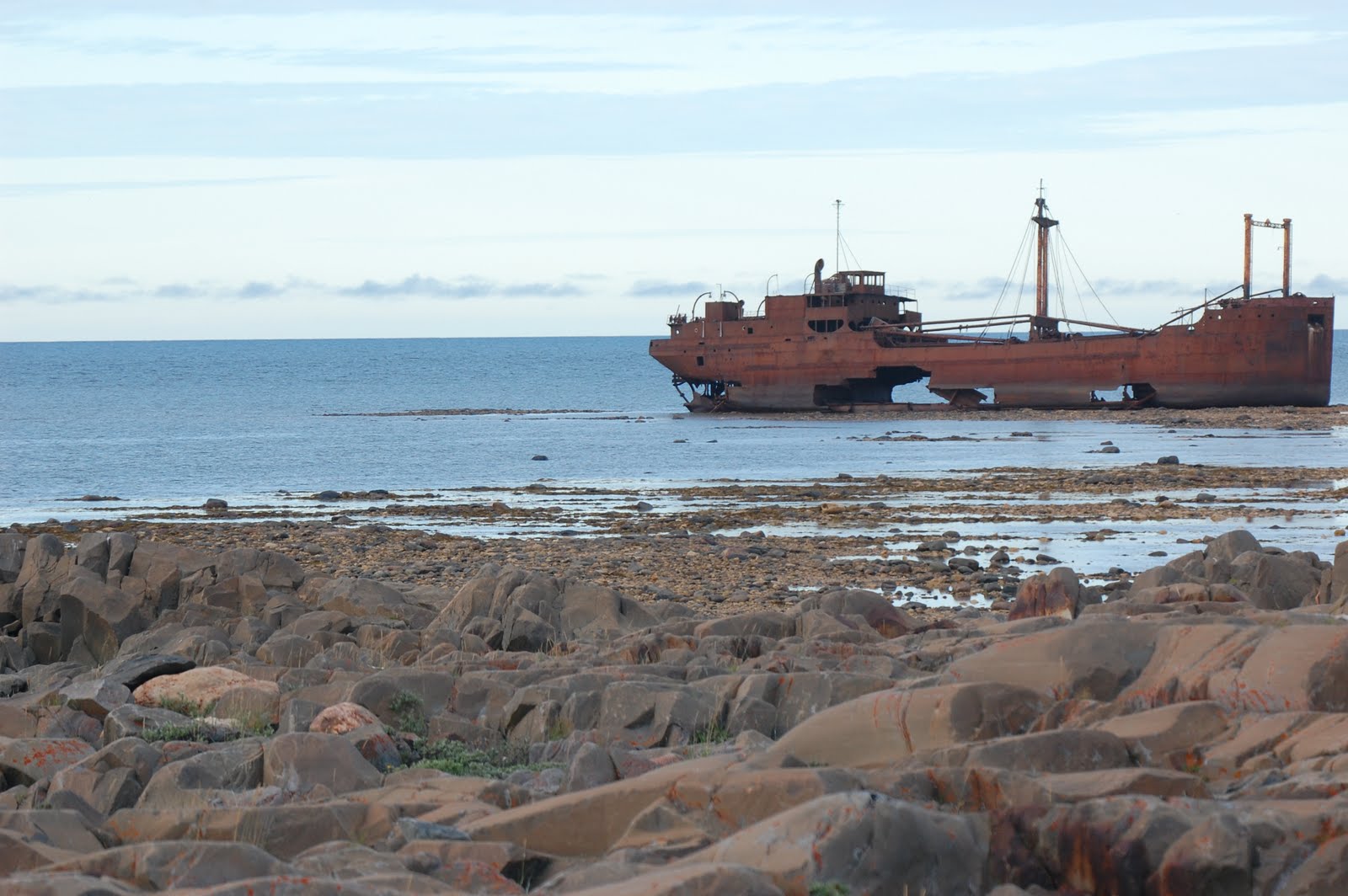
Tonight's adventure, walking out to the Ithaca at lowtide.

Our fantastic bear guard, Krista, taking it very seriously! Thanks!

The Ithaca


This is Caleigh and Krista: "I wonder what would happen if I
squeezed it..."

It squirts out!

Matt karate chopping the giant kelp (we were walking on what
is normally under water so there was kelp and seaweed and algae
everywhere.)

Ribbon cutting ceremony: attempt number 2

We mad it!

There is a hole in the hull. Hi Celia!


Let's all jump at the same time on a rusting out ship with
holes in the floor. Great idea!

Not what we wanted to see: A polar bear came up on the bluffs
between us, out at the Ithaca, and the trucks. Luckily, it decided
that it wasn't interested in us and wandered away down the beach.
Thanks to Krista, who took charge, we all made it safely back to
the trucks without firing a shot. 

Bright sunsets

And neon pink skies.

Also interviewed the other plover lover, Anne. Thanks for the great interview today!

And found three really cool articles for my research on pigments and their use on the benthic and phytoplankton communities + (unexpectedly but awesomely) a nutrient study combining the pigment analysis! How perfect is that?

Sunday, August 7, 2011

Day 68: Snapshots

Today, I saw two red fox, a vole, a golden eagle, countless small fluttering birds and a wolf (too brief and far away for a picture), within the span of 20 minutes driving down Twin Lakes Road toward West Twin Lake to do the water sampling. I like being the first one in the field, the first to disturb the wildlife and the first to see it.


Today, I found some really bizarre looking algae at Coast Pond. Let's do an ink blot test. What do you see? I see green algae that has made some sort of enclosure to capture escaping gas, probably CO2, but that is just my nerdy side cracking through.


Today, I poked the abdomen of a female spider until the baby spiders crawled off so I could count how many there were for the Godwit team. I think I still have a bit of a fear, irrational but present, of spiders.

Today, I interviewed amphibian ecologist, Ben Cash. The landscape came to life with his words as only a true naturalist has the power to do.

Today, I interviewed a plover lover, Lisa - also my rocket climbing, firefly watching buddy. I wonder if the mismatch hypothesis might actually be a benefit to the species... Anne? I will ask her tomorrow. And I'm going to make you, dear and precious reader, wait a bit longer to even know what that means. Though I will give you a hint to go back to the post Research in Action.

Today, I discovered that I have a select number of days left in Churchill and that I am secretly, almost unconsciously and certainly regretfully counting them down. I am making a conscious effort to instead keep counting up.

Today, I only wish to give you a few snapshots, snacks of the stories that each hour here accumulates.

Tuesday, July 26, 2011

Day 56: Science Media

There was definitely an overwhelming theme to today's work - Media. More specifically, media and science.

A lot of the researchers are leaving at the start of August, which gives me less than a week to get some of the interviews conducted for my podcast, Avioyok. The goal of my podcast is to translate specialist scientific knowledge that each of the researchers conducting their studies at CNSC have into something that the public can understand. As my ecology professor said, referring to studying for exams, you should know each topic well enough to be able to fully explain it to your grandmother in one sentence. I don't mean give the basics of the topic, but to really understand the meaning behind the concepts that the technical words for the concepts aren't needed. I'm trying to get the complex research down to the one sentence that will eloquently explain the entire project. I'm trying to do this while still having fun with the interviews, making the researchers I'm interviewing feel comfortable, make it a learning experience for the people I'm interviewing (since they are students that may never have had a real interview before, but if they stay in science, will probably be interviewed many more times).

And I'm also trying to follow a journalistic ethical code that I think is lacking in normal interviews. The main one here is transparency. Too many reporters will interview a scientist just to get the one quote of "toxic cyanobacteria bloom in the lake" without understanding any of the context. They come into the interview with a story already written rather than discovering the real story that the scientist has to offer. In transparency, I want to make sure my intentions are stated up front. This means that I give the person I will be interviewing a letter that describes the exact nature of my project, gives a sample of questions that may be asked in the interview (before the interview so the researcher has some time to think about it), that the researcher is free to participate or drop out of the project at any time so I won't be able to use his/her voice if he/she decides not to be part of it anymore, and the inclusion of the researcher in the process of the creation of the story, sharing a copy of the transcript of the actual interview, and letting them see/hear the edited piece before I give it to the public so they can get a sense of whether what they said is being used out of context. These are constraints I place on myself to keep me honest and to keep me working towards the real story rather than the story I thought I saw in my head. Of course, it is always risky to allow the person you are interviewing to see the project before the public does, I mean, what if the researcher hates it? But in this situation the transcript can back me up because it is truly what is said, giving me the argument for the story I chose. This is a system that protects both the person being interviewed and the interviewer. This podcast will be my test to see if this philosophy could actually work.

So today was the first day of interviews. I woke up at 5:30 to hop on a bike and get out to the field by 6 AM with yellow warbler researcher, Vanya. I had my mic hooked up to my backpack and just kept asking Vanya questions as we walked and biked from nest site to nest site. It was more of a continuous stream of questions that I was simply curious about, rather than an interview. I'm glad he put up with me!
Yellow Warbler chick!

A young arctic fox sat right in front of us, eating possibly one of the yellow warbler chicks, and then ran right up to us, just a few feet away as though we weren't even there, until it lolloped away across the tundra!

I followed up the field interview with an indoor interview. I had to do this just to make sure that I actually had some good audio data. Recording anything outdoors, even if it isn't windy as it wasn't today - unusual in Churchill - is always a huge risk in quality. By the time I was done, I had a solid 3 hours of audio from Vanya which I will need to edit down to something closer to 20 minutes! That task is daunting!

I took a break from my own interviews after the morning only to find out that there was a production crew at the Centre to interview LeeAnn and the science staff to learn about the work they do. I was going out with Jessica to help her with her lake samples in the afternoon and this production crew was going to come out with us as well! I knew I wasn't going to be interviewed myself as the field assistant, but I also knew that even if they are using Jessica's stuff as background footage, they would probably want to know what Jessica's research is. So I chatted with Jessica to help her develop the short explanation of her project - that one sentence, 10 second thing. From experience, I have found that if you let the person interviewing control the messages of the interview, the real story will be lost. As the scientist being interviewed, the best defense against this is to develop that one message that you can share, so the reporter can only use this message without being able to cut it short or misunderstand it. You have to direct the interview to the story you have, not the other way around. So when we were out in the field doing the sampling, of course, they did ask Jessica the question - what are you studying. I'm glad we talked about it because she did so well explaining the project!

That was the afternoon, which left the evening open for two more interviews with two members of the Godwit crew, Andy and Madi who leave on Thursday! Back to back 1 hour interviews! It was a more formal interview style in a classroom where I asked similar questions to both of them. It was really interesting to hear how the two of them responded completely differently to the same questions, same facts, but a slightly different style and take on the events. I still have Hope and Hannah to interview before they leave next week to complete the crew that are still up here. I also want to interview the grad student who hired the crew, Nate, but that will probably wait till the fall and be a phone interview.

I'm so glad to have finally done some interviews before people left for the summer. I was getting a bit nervous that I wouldn't actually have any audio from this summer, but I suddenly have 5 hours worth! And having done the interviews, I'm starting to think that I really can pull this off!

Friday, July 22, 2011

Day 52: Food

Today, I enjoyed the taste of chocolate ice cream with raspberries. A delicious combination that was unexpected and extremely satisfying. I haven't had ice cream since I left the south, and the Northern, the only grocery up here, doesn't sell berries, so I haven't had that either. The ice cream was courtesy of Krista and the berries of Matt, so I thank the two of you so much. I don't know how you intuitively knew that I was craving chocolate ice cream!

But thinking about food, especially about the food I can't have access to up north, I started wondering about the food I do have access to. I can't actually make my own food up here beyond trying some crazy combinations with the toast, apples, bananas, oranges, honey, teas, and cereals that are left out at all hours - I have gotten pretty good at making a cinnamon apple toast crunch! So I am at the mercy of whatever Rob decides to cook up. This is where being a vegetarian gets a bit tricky.

I am a vegetarian, a moral choice I made for several reasons that many vegetarians share - health reasons, animal cruelty in the factory farm industry, environmental reasons. It is easy in the south to make choices that are much better for all of these areas - eating locally grown food, fresh food that I make myself. Easy. But the choices are much harder up here.

To truly eat local in Churchill, I would have to eat off the land, mainly eat wild game. The option seems logically reasonable. Eating wild food is healthier. It creates a direct connection between what you eat and the animal that you had to kill to eat it, which is a much deeper connection to food that I could ever have, even growing my own vegetables couldn't compare to taking the life of a goose or a caribou for food. This concept is largely related to the 100 mile diet, eat what is available to you within 100 miles.

So here is the problem with that philosophy. I am staying at a place where food is being prepared for me from plants that have traveled at least from Winnipeg and probably further, especially the bananas and oranges, to get all the way up to Churchill. The environmental impact is huge just from the travel of the food I am eating. The chef also prepares more food than everyone can finish during a meal. Some of it is reused, and he is pretty good at this, but a lot still gets thrown out. So if I already accept that I'm eating plants that are traveling from so far away, what would be the difference if I ate the meat that is already prepared and will be thrown out? Every other reason for being a vegetarian up here has already been compromised. There is still the carbon footprint of the meat itself and the amount of food that the animals have to be fed to make that meat, so maybe the veggies still have the upper hand.

I'm somewhat unique among vegetarians because I don't crave meat. The scent of chicken makes me sick, the scent of bacon doesn't make my mouth water, but makes me want something green. So I'm not tempted to eat meat. The thought of meat itself makes me sick. When I think of it, I don't think about it as food. I think of it as a dissection.

I'm wondering how right my choice is to eat what I'm eating up here anyway. If I would really follow the philosphy I proposed, I would still find a way to cook my own food and still only eat local foods - which wouldn't mean being a vegetarian.

Yet, if I am so strict about what I eat, am I going to miss out on the enjoyment of eating itself? When there are people starving in this world, shouldn't I be happy that I get food at all?


I'll end that thought there and add here, at the bottom of the post, an update on my experiment. It's done! Emma helped me empty the pool. After safely getting all the containers back into the lab and filtered with Jessica and Emma's help, Emma and I tilted the pool onto its side so the water easily flowed out. But remember that we were on the roof? The flowing water fell down the side of the roof onto the lower tin one, making an avalanche of lake water rain down onto the lab below. It was a pretty cool sight with the wind blowing the mist back up at us as the water fall crashed, holding a pink blowup pool on top of a roof in Churchill.

Tuesday, July 19, 2011

Day 49: Research in Action

Today was the BIG SPIKE! So we spiked at 8:00 and sampled, then filtered, then sampled... then filtered... then sampled... 3 times! It takes a while to get this done. And as the day went on, it got colder and wetter, which was... great! Thanks to Ema and Jessica for the great help today! We weren't able to finish the filtering because we decided to go on the Research in Action tour instead. So filter tomorrow, then another sample and another filter... deja vu? Oui!

I broke out the audio recorder and the mic that LeeAnn lent me to take with me on the Research in Action tour which is a tour that picks people up from town and drives them to some of the sites that the researchers are working at where the researchers present. We had a great turn out of around 50 to 60 people would be my estimate! The recordings turned out pretty well, but you will have to wait for the podcast for that! 

This is Ann's talk (in black on the left). She is studying
semipalmated plovers and the mismatch hypothesis. Basically,
this means that the insects, which the plovers eat, are hatching
earlier because the temperatures are higher (climate change)
earlier. So traditionally, the plovers, and other shorebirds,
timed their migration, nesting and mostly the timing of chick
hatching occurs at the same time as the peak of the insects so
there is enough food for the chicks! With climate change, and
the insects hatching earlier, the hypothesis is that the chick hatching
time will not change as quickly as the peak insect time. Bad news
for the plovers. Ann is catching the chicks and the insects so
she can see if this is in fact true!

This is Hannah's talk (in blue on the right). She is the field
team leader for Nate's project studying Hudsonian godwits
and whimbrels. These are both shorebirds, but not much is known
about them. Specifically, they don't know how they migrate,
or how they nest, or how the chicks grow, but they are pretty
amazing birds - migrating from Churchill to the lower tip
of South America, male and female share of responsibilities of
chick rearing , the dramatic physiological changes to prepare for
migration and then after the migration. So most of the work
is trying to locate the nests and then capturing the birds
to put a data logger and tags on them and to get weight and length
measurements and blood samples for DNA and disease detection.
Here, Hannah is modeling how a bird trap works with a volunteer.
The trap snaps closed when you pull the fishing line after the
bird wanders back to its nest. It doesn't hurt the bird.

This is Celia (in pink/purple)! She is
holding a zooplankton net to sample the
lake for zooplankton (found anywhere in
Churchill, if there is a lake that doesn't have
zooplankton, tell Celia... she will be super
excited)! She talked about the importance of
zooplankton in the food chain as a connection
for nutrients and energy between algae and fish.
She also talked about how there are 7-8 species
in each pond and that the community can vary
greatly even between lakes right next to each
other! The communities also vary because
the environmental changes can be severe
because the volume of water is so little.
Specifically, she is looking at how different
communities that she gathers from various lakes
 can establish under different nutrient and
 salinity conditions. She is also interested in
seeing how zooplankton can establish between
lakes - how do they get from lake to lake.
So she has windsocks set up between lakes to
try and capture these resting eggs that the zooplankton
lay to survive winter and harsh conditions
(they can survive for decades in the sediment and
can actually be hatched after 70 years! This
hatching is called resurrection ecology!)
The theory is that the resting eggs are being blown
by the wind between ponds. They could also be
transported by animals or their feces!

This is Vanya (with the yogurt container around his neck!).
He is studying yellow warblers (little droplets of sunshine!)
and is looking at geographic variation of their nest morphology.
So he is holding two different nests in his hands here. One is
a nest made in Churchill, and the other in southern Ontario. The
fluffier, bigger one is from Churchill, the shallower, more woody
one is from Ontario. And he is interested in why the same species
makes such a different type of nest depending on location.
One thing he did find was that it takes 1500 trips for the
females in Churcihll to make the nests and only 500 trips for the
Ontario females! There must be some advantage!
Does it effect the chick growth? Is it warmer or cooler for the climate?
Will it hold more water or less? Or is it even an ancestral quality
that reflects the adaptations to the little ice age? Or maybe
it's just the time investment difference because southern birds
get predated more often and have to rebuild their nests many
times over the nesting period whereas the Churchill ones will
usually build it only once or twice? Vanya thinks this one since
the temperature, the moisture, and chick survival don't seem to be
different. Another thing, Vanya goes around and switches the
nice fluffy Churchill nests with Ontario nests and vice versa down
south - moving them from mansions to shacks to experimentally
manipulate the nests and see how all these variables are
effected. I feel sorry for the ones that get the shacks, but from
the research, it doesn't seem to matter all that much... 

Friday, July 15, 2011

Day 45: Music

The Sound of Music to be precise. That's right, I'm finally watching the movie that my Dad has rejected my entire life, up here in Churchill, the sing-along version that has the words on the screen during the songs. So songs have become the theme of the night.

First song, singing in the rain.

Thursday is the normal sampling day, so I did my seven lake samples and filtering yesterday. This morning, I went out to get seven additional samples during the rain event. Yep, it's raining again. It rained all day in buckets and breaks. Today was supposed to be the day that I started the second experiment, gathering the sediment and lake water to add the nutrient spike to on Monday. However, because it was raining, and raining so hard, the sediment was extremely disturbed and the water chemistry would have been completely different from the normal days. Which is why I've been sampling the lakes during rain events. So though I couldn't start my experiment today, and plan on starting it on Sunday, I did the during rain water sampling.

I tried to take a picture of the
mosquitos, but I failed. You
can barely see them, though
I know they were there!
So while there was one break in the storm this morning, I ran out with Carley to get the during samples. It didn't rain, but the mosquitos were maybe the second worse they have been since I've been here. The worst so far was on the ATV day when I went out to hunt fox dens with Ryan. I still have some bites from that day that have yet to disappear. Today was bad though, making taking pictures of the lakes a shaky experience every time I raised the camera - slapping at my hands against my thighs every other second. I think it's the humidity that makes them come out.


I'm sampling in the rain,
just sampling in the rain.
What an irritating feeling,
And I'm bitten again...


But that was the morning. I went again right before dinner with LeeAnn. This time there was at least a breeze to keep the mosquitos away. Then I got rained on while sampling the last lake. My good karma didn't last quite long enough to keep us dry.

A moment to break out the nerd in me. There was surface flow! There was surface flow into Puddle and into Strange from the inflow areas that we've been sampling. This was the first time that I've had surface flow since my initial walk around when there was still snowmelt during my first week here!

Song number two: Un Canadien Errant.

I had 156 centrifuge tubes to label for my experiment, 156 scintillation vials, and notebooks, containers, lids and various other assorted items that had to be labeled. I got most of it done while watching Eat, Pray, Love and listening to some podcasts yesterday. Today, I labeled the 156 centrifuge tubes while watching One Week with everyone. Un Canadien Errant was one of the songs in the movie. It was a really good movie and makes me want to travel Canada coast to coast.


Maybe I have travelled to a foreign country by coming up to Churchill. And though I do miss my home, family, and friends, the sad words of the song do not fit my mood today.

I barely knew anyone up here before I arrived, only having met LeeAnn and passed by a few of the other researchers last year and at the CNSC Winnipeg conference. Now, I eat and laugh with, watch movies with and work in the field with, make dioramas and t-shirts with new friends.

I have dove headfirst into the salty, icy waters of Hudson Bay, having never swam in salt water before. I have seen snow and ice in June. I have seen polar bears and caribous, fox and hares, dunlin and godwit chicks. I have seen the season change from winter to summer, from barren brown to a purple carpet, to a white carpet, to a green carpet with touches of pink, white and purple scattered in the green peat.

Thursday, July 14, 2011

Day 44: Delegation

I find it difficult to tell other people what to do. I know what has to be done and I have my lists of tasks to get done, but I find it really difficult to tell other people to do them. It's not that I don't trust that they won't do the job right, but I'm afraid that I might tell them to do something that they know is wrong, but they won't say anything because I'm supposed to be in charge. I also don't know how much they can take, so I don't know how much or how little to assign. I suppose that learning how to delegate is important if I'm ever going to be a leader or just run anything. I don't know why I find it so difficult. What am I supposed to do? How do I get better at it without offending anyone? I don't think I have that kind of confidence.

Ema and Jessica arrived yesterday. They will be helping me with my project in exchange for me bear guarding for them and helping them with their projects. So I've been telling them what to do, and will be continuing this when I take get my cores and lake water tomorrow to start the second part of my experiment, and they ask my advice on how to take a lake core or where to sample. I wish I knew more so I could truly help.

Tuesday, July 12, 2011

Day 42: 42 cannons

Today, I woke up early to go to the Prince of Wales Fort to help LeeAnn fix some of the data loggers that didn't seem to be collecting any data any more. I had two things to bring, my laptop and a USB to serial wire. I forgot the wire, making the laptop useless for connecting to the loggers. I have to be more careful about making sure I bring what I need. Luckily, LeeAnn had a backup method, but I felt pretty foolish.

So what is the Prince of Wales Fort? 

Aerial view of the fort at Eskimo Point. Construction began in
1731 and lasted 40 years! It was commissioned to protect Britain's
interests in the north for the Hudson Bay Company when the British
and the French began to lose their friendly relations. It has the
famous four bastion layout to provide 360 defense of the mouth
of the Churchill River. 

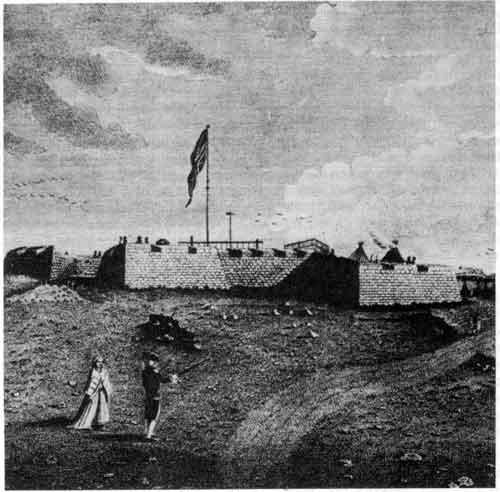
Samuel Hearne's rendition of the fort. Hearne is a famous
English explorer, novelist, fur trader, naturalist, you know
the stereotyped Englishman of the early 1700s. He was also
the Governor of the fort during the great battle of 1782...

Can you read the inscription above the entrance way? It's
in English, if that helps. I'll give you a hint, click on the picture
to open it and see it big. In fact, you can do that with any of
the pictures on my blog!

So this is the fort today. Since 1930, it has undergone restoration
projects that will finally come to an end at the end of the summer.
To do this, students studying to be masons are up here with their
instructors along with archeologists who make sure everything is
historically accurate and the real bits are preserved.

So what happened to the fort? Why the restoration? Well, in
1782, Churchill was invaded by the French who had three
warships. Though the fort had 42 cannons, only 22 men were
there to defend the mouth of the Churchill River. Jean-Francois
de Galaup, comte de Laperouse, a famous French explorer
 came up to the fort in three warships, outnumbering the firepower
of the fort itself. So Hearnes, the English Govenor - remember him,
surrendered. The French partially destroyed the fort and shoved stuff
into the cannons so they couldn't fire again. Thus the purpose of the
fort failed. But we now have a La Perouse Bay near the fort in honour
of the Frenchman - because Canadians are like that.

Having walked through this fort with big stone walls, I have no idea how they survived the winter. 

"As one post governor reported in 1741, the fort's living quarters were '... very cold, freezing everything in the cabin, though a fire kept in from five in the morning till nine at night; and when the fire is out, a red hot shot, twenty-four pounds weight (a cannon ball) hung up at the window to thaw it; on the outside there are shutters to every window, six inches thick; four large fires made in the stoves every day - a cartload of wood for each; yet all this will not keep things from freezing within doors.'" (From Parks Canada)

The treeline on the same side of the river as the fort is greatly depressed in comparison to the other side of the river. Why? Well, to feed those "four large fires made in the stoves everyday - a cartload of wood for each." That's a lot of wood anywhere, but especially in a place that gets to -50/-60 C regularly in the winter. This is yet another fine example of how people do not take advantage of the environment around them. Put another way, this is another fine example of how Europeans tried to implement something that might work back in Europe where it is comparably warm in a new environment where the resources aren't there and you simply can't live the same way.

What did the inuit do to survive the cold? They built snowhouses, igluvijaq, that used the snow as insulation. The design used the resources available in the immediate environment so well that just by sitting in one, you could raise the temperature in a house between -7 C to 15 C when it is -50 C outside, just with body heat.


Innovations like this, built off of the environment itself, using the physics and traditions of a culture, make sustainability. Sustainability is unique to every region. From the structure of buildings to eating food that is is found in the region, such as caribou and other bushmeat up here. When will we learn this lesson?

Side note, there was also a polar bear about 200 m from the fort, far enough away not to bother us, but the bear monitor kept a close eye on him. That makes 7 polar bears. That's enough that I no longer feel the urge to take a picture of a little white dot on rocks. So I'm sorry, but no picture of a polar bear today.

The other note I would like to make is that today was 28 C. The hottest it has gotten here today. Being in a bug jacket and long pants in 28 C is torture! I came to Churchill to escape the heat of southern summer. But we fixed that by jumping into Stigge Creek.

Introducing the swimming gang: Brit, Krista, Celia, LeeAnn,
Carley, Trigger and Dez (Carley's dogs), and me

That's me with Trigger! It was really nice to swim without
worrying about fish or crayfish or any other critters sneaking up
to you and nibbling your feet!

Sunday, July 10, 2011

Day 40: The unexpected truth

Here's a thought: maybe nothing went wrong with my experiment at all. If something doesn't go as expected, the first instinct was to think something went wrong: so I tested the spike solution, I tested the containers, we tested the machine it was analyzed on, I tested the DI... All of the tests baffled us more because they kept eliminating the problems and saying that we did it right. What if there isn't a problem, what if what was observed are the true results?

So we got back the total phosphorus concentrations in the water. Total phosphorus measures a lot more than the soluble reactive phosphorus, the orthophosphate that  are directly taken up by plant cells. Total phosphorus is a measure of the dissolved and the particulate phosphorus. When we got the total phosphorus back, it was there! We really did everything right! The phosphorus just got converted into other forms faster than we thought possible. Definitely really interesting! It means that this pond may regulate the phosphorus geochemically before there is even a chance for the algae to really take it up.

Sometimes it is so hard to believe what is actually happening if it is different from expectations.

Friday, July 8, 2011

Day 38: Whale Connections

I reran the Hach phosphorus tests to see if there are any additional effects by the containers after a couple of days. So this is the results after roughly 72 hours. Containers are not absorbing nutrients!
All the DI transport containers still show blue compared
to the pure DI with no phosphorus in it.

Same with the DI incubation chambers. Therefore, I don't think
that there is an effect by the containers.

For the lake water containers, only the 50x was really still
blue, but this could actually mean that the phosphorus was
used up by they phytoplankton, which makes sense.

Same with the lake water in the transport containers. 

I also wanted to introduce Harry who joined the CNSC staff this summer in maintenance. For the ITEX experiment (remember the Dryas?) I had to make a stand to mount thermal sensors onto. The stand was to be made of a wooden dowel and I had to make grooves into the dowel so the wires and the metal sensors would be protected. First, I tried to carve it out with a knife, which was more apt to slice into my fingers. Then I tried a hand saw, which just started to split it and didn't really make anything wide enough to become a rounded groove. I eventually gave up and decided to seek the advice of Harry in the workshop. Of course, he had a tool for it - not that I know the name. It was a hand held electrical circular saw which he expertly used to carve the perfect, smooth groove into the wood. Watching him work was like watching an art form, which it was - he was making art. He knew exactly how much pressure to use to get the slowly deepening groove. He would rock the blade to smooth the channel and make it perfectly round. When the saw would sometimes spark, he didn't flinch like I did, but remained holding firmly, knowing always where the blade was. The scent and warmth of wood dust in the garage with sparks flying... He is an inuk who builds ulu stands out of wood and komatiks for children. The skill was fascinating to witness.

An ulu is a woman's all purpose knife.

A komatik is a sled traditionally pulled by dogs. Harry told me
that he makes them to pull children in the winter, like a little red
wagon, he told me.

One of the volunteers, Sarah, was telling a story about how when she was a little girl in Minnesota, she would sit and watch the beluga whales in the aquarium for hours. Any other time, she would be running around and jumping on everything, but for the belugas, she sat and watched. Fascinated. Harry then told a story about his brother. The first belugas in captivity were from Churchill. Harry's brother was hired to capture some belugas in the bay years and years ago. The crew would select a young one that could still be transported. Harry didn't describe how they were captured, but somehow they would get the whales into the boat and hoist them up into a sling, like a hammock. Then they would have to spray the whales to keep them moist for their journey to an aquarium somewhere in the world - from New York to Japan, and Minnesota. The whales that Sarah was excited to see as a little girl were captured by Harry's brother in 1978. They were named Anookalik and Anana. They have since passed away. Most now are bred in captivity and are no longer captured in the wild. It's a small world sometimes. 

One of the beluga whales that was in Duluth, Minnesota from
Churchill, Manitoba.