Showing posts with label My Experiment. Show all posts

Wednesday, January 25, 2012

Apply for TEDxWaterloo 2012 - Check!

I just applied to TEDxWaterloo, a local affiliate of TED talks that presents speakers from a variety of different disciplines and backgrounds, revealing a new perspective, an adventure, an innovation, an inspiration! In the application, they asked about current involvement in the community and why I wanted to attend TEDx and I ended up writing about the podcast and my research, so I thought it would be fitting to repost that here. I often write about the difficulties and proceedings of creating a podcast and conducting the research that I sometimes forget to write about how much I enjoy it. I do enjoy it!
I'm a Knowledge Integration student which means that my life consists of jumping between disciplines, trying to come up with new ideas with a bunch of different people, and mostly studying hard, learning hard, and playing hard. I am also an advocate for northern research, being a northern researcher myself - I just got my first publication for my work on arctic ponds, wuhoo!!! Being an advocate means promoting research in the arctic and subarctic, so I am creating an audio podcast - Quirk and Quarks-esque or RadioLab-esque - to tell the world about the amazing research going on at the Churchill Northern Studies Centre near Churchill, Manitoba which showcases the noticeable effects of climate change on all sorts of organisms, from migratory birds to invertebrates! Only in northern research can we say, yea, look, climate change IS happening and it is truly harming northern-adapted organisms. The research I'm promoting is also unique because it is student run, either by grad students working on the edge of existing knowledge of the species or high school students getting their feet wet for the first time while working on long term monitoring projects. This is important stuff, and important to continue studying, which is why I'm a northern research advocate!

The rest of the time (when I'm not playing in water and sediment or interviewing and editing for the podcast) I am busy trying to get the most out of my undergraduate education - so much to learn, so little time! And the best part about learning is that it can occur in any context, it doesn't have to be from a textbook or a professor's lecture, it can be impromptu discussion in a coffee shop, an observation of changing seasons on a walk, or during the mingling of strangers after hearing an inspirational speech on the transformations of jazz or the power of light to create innovating technology at an event such as, dare I say it, TEDxWaterloo!! I live for these interactions with strangers from different backgrounds, whose biases colour their lens of the world and when placed in discussion with people with different biases allows everyone to see the whole spectrum of illumination. It is my fourth and final year at UWaterloo, after which I will enter into the "real world" and have to grow up and I want to be reminded that growing up doesn't mean conforming, it means continually learning, pushing the boundaries and fighting for what you believe in. I want to be inspired.
Apply to TEDxWaterloo for March 21 - deadline is Jan 27 so hurry up! - And I hope to see you there!

Tuesday, January 10, 2012

Month 9 of Project

I am back in Southern Ontario, having left the beautiful landscape of Churchill on August 25 after the grand opening of the new building for the CNSC. I returned from a pleasant 20C to grueling 30C, watched the season change a second time, this time in the south, from a hot summer again to a golden brown fall to a warm, drippy winter. Over the past 4 months after being airlifted out of Manitoba, I have continued work on both of my projects, the microcosm experiment and the podcast. And I feel it is time to revive this blog and see the projects through to completion!

Microcosm Update: Many statistics have been calculated, many conclusions have been drawn, and many more questions emerged with much more to discuss around the topics of arctic pond ecosystems, the role of bacteria in the benthic mats during nutrient uptake, separate responses to nutrient additions for the water column community and the benthic community, the hindsight problems methods that I wish I could have changed (why didn't I take pH readings of the microcosms?), the question of accurate representation of lake conditions, et cetera, et cetera, et cetera.

I wrote a preliminary report and presented to the Waterloo/Laurier group on the findings for an Independent Studies course which will be shaped, poked, and prodded, this term, into a publishable journal article. The data consists of the levels of the added nutrients in the water column, the chlorophyll a response from the phytoplankton and from the benthic community and an analysis of other pigments which needs to be completed this term using High Performance Liquid Chromatography (HPLC). Because the data will be published, I can't release it here, but I can discuss some of the broader questions (which I began this section with).

Stay tuned for further discussion!

Podcast Update: Avioyak (remember the buzzing in ears?), my obsession and creative outlet, is slowly coming to life along with the voices of the scientists I have not directly spoken with for several months! Two episodes, the one featuring Anne and Lisa's work with semi-palmated plovers and the one featuring Vanya's work with yellow warblers, are nearly complete. Remaining are the episodes on the Hudsonian godwit, zooplankton, and long term wetland monitoring. March 9, 2012 - Look out for the release!

In October and November, I ran a series of surveys asking CNSC visitors to listen to an episode, give me their overall impression of the style, and answer some factual questions to see if they learned anything. I never anticipated conducting a survey to be so difficult. Of course, the logistics, the hard deadlines, and the analysis are difficult, but that is not what I am referring to. Conducting a survey about the design of my own creative outlet, my brainchild, my art that contains my personal opinions about how science should be presented to the public and what I think is creative and fun, is truly difficult because of the critical feedback where listeners just didn't necessarily get it. The purpose of the survey was to learn about what the target audience might not "get" or what they think should be improved and, in design theory, this is exactly what designers are supposed to do. But in practice, I am so close to the project that it is very difficult not to take the comments personally even when I know the comments are constructive criticism.

Constructive criticism. Constructive: focus on the constructive because a lot of the comments really could help in the construction/conceptualization/development of the next episode, such as maintaining level sound quality, slowing down the narration, having distinct sections etc. Unfortunately, it is hard not to continually hear the criticism of my ideas and my art, the heartbreak of not being understood as I am sure so many artists and creatives have encountered. So to my future self and to others who are putting their creative selves on display, and especially for those that are honestly seeking the constructive criticism of others:

"Creativity takes courage."
- Henri Matisse
"Do what you feel in your heart to be right,
for you'll be criticized anyway."
-Eleanor Roosevelt

"To escape criticism - do nothing, say nothing, be nothing."
- Elbert Hubbard
By far, the biggest challenge was getting over the criticism which I willingly asked for! But tears were not shed in vain! The podcast and I am stronger for it and I am doing something, saying something and being something!

As the podcast develops this term, I will keep you updated and I am sure keep you informed of the latest rants of the media/science/Churchill obsessed producer. Until then... the latest wintery welcome by Kat.

Monday, August 8, 2011

Day 69: Once in a lifetime

Last night, the Aurora Borealis:


Over a setting sun at 23:45


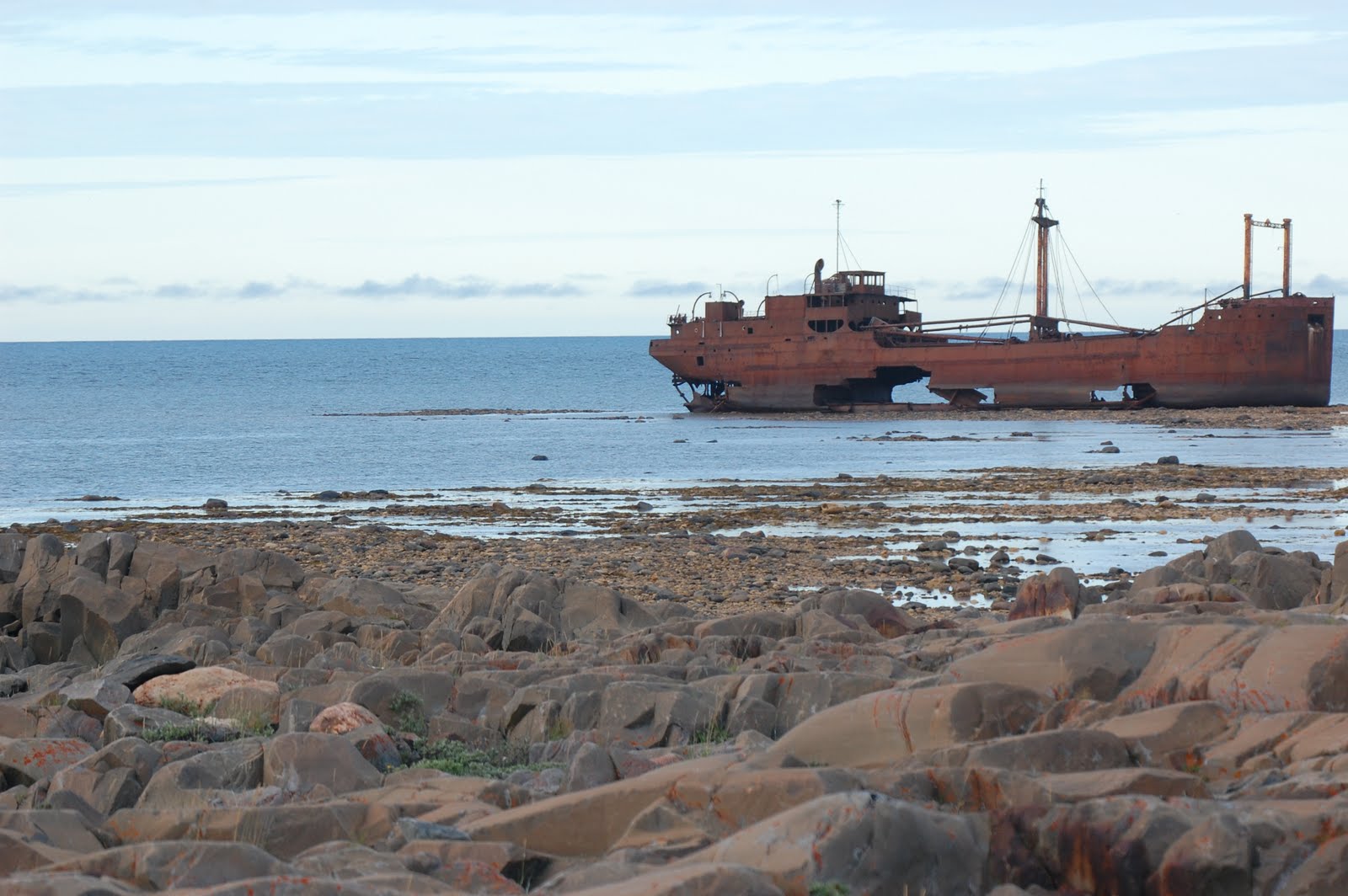
Tonight's adventure, walking out to the Ithaca at lowtide.

Our fantastic bear guard, Krista, taking it very seriously! Thanks!

The Ithaca


This is Caleigh and Krista: "I wonder what would happen if I
squeezed it..."

It squirts out!

Matt karate chopping the giant kelp (we were walking on what
is normally under water so there was kelp and seaweed and algae
everywhere.)

Ribbon cutting ceremony: attempt number 2

We mad it!

There is a hole in the hull. Hi Celia!


Let's all jump at the same time on a rusting out ship with
holes in the floor. Great idea!

Not what we wanted to see: A polar bear came up on the bluffs
between us, out at the Ithaca, and the trucks. Luckily, it decided
that it wasn't interested in us and wandered away down the beach.
Thanks to Krista, who took charge, we all made it safely back to
the trucks without firing a shot. 

Bright sunsets

And neon pink skies.

Also interviewed the other plover lover, Anne. Thanks for the great interview today!

And found three really cool articles for my research on pigments and their use on the benthic and phytoplankton communities + (unexpectedly but awesomely) a nutrient study combining the pigment analysis! How perfect is that?

Friday, July 22, 2011

Day 52: Food

Today, I enjoyed the taste of chocolate ice cream with raspberries. A delicious combination that was unexpected and extremely satisfying. I haven't had ice cream since I left the south, and the Northern, the only grocery up here, doesn't sell berries, so I haven't had that either. The ice cream was courtesy of Krista and the berries of Matt, so I thank the two of you so much. I don't know how you intuitively knew that I was craving chocolate ice cream!

But thinking about food, especially about the food I can't have access to up north, I started wondering about the food I do have access to. I can't actually make my own food up here beyond trying some crazy combinations with the toast, apples, bananas, oranges, honey, teas, and cereals that are left out at all hours - I have gotten pretty good at making a cinnamon apple toast crunch! So I am at the mercy of whatever Rob decides to cook up. This is where being a vegetarian gets a bit tricky.

I am a vegetarian, a moral choice I made for several reasons that many vegetarians share - health reasons, animal cruelty in the factory farm industry, environmental reasons. It is easy in the south to make choices that are much better for all of these areas - eating locally grown food, fresh food that I make myself. Easy. But the choices are much harder up here.

To truly eat local in Churchill, I would have to eat off the land, mainly eat wild game. The option seems logically reasonable. Eating wild food is healthier. It creates a direct connection between what you eat and the animal that you had to kill to eat it, which is a much deeper connection to food that I could ever have, even growing my own vegetables couldn't compare to taking the life of a goose or a caribou for food. This concept is largely related to the 100 mile diet, eat what is available to you within 100 miles.

So here is the problem with that philosophy. I am staying at a place where food is being prepared for me from plants that have traveled at least from Winnipeg and probably further, especially the bananas and oranges, to get all the way up to Churchill. The environmental impact is huge just from the travel of the food I am eating. The chef also prepares more food than everyone can finish during a meal. Some of it is reused, and he is pretty good at this, but a lot still gets thrown out. So if I already accept that I'm eating plants that are traveling from so far away, what would be the difference if I ate the meat that is already prepared and will be thrown out? Every other reason for being a vegetarian up here has already been compromised. There is still the carbon footprint of the meat itself and the amount of food that the animals have to be fed to make that meat, so maybe the veggies still have the upper hand.

I'm somewhat unique among vegetarians because I don't crave meat. The scent of chicken makes me sick, the scent of bacon doesn't make my mouth water, but makes me want something green. So I'm not tempted to eat meat. The thought of meat itself makes me sick. When I think of it, I don't think about it as food. I think of it as a dissection.

I'm wondering how right my choice is to eat what I'm eating up here anyway. If I would really follow the philosphy I proposed, I would still find a way to cook my own food and still only eat local foods - which wouldn't mean being a vegetarian.

Yet, if I am so strict about what I eat, am I going to miss out on the enjoyment of eating itself? When there are people starving in this world, shouldn't I be happy that I get food at all?


I'll end that thought there and add here, at the bottom of the post, an update on my experiment. It's done! Emma helped me empty the pool. After safely getting all the containers back into the lab and filtered with Jessica and Emma's help, Emma and I tilted the pool onto its side so the water easily flowed out. But remember that we were on the roof? The flowing water fell down the side of the roof onto the lower tin one, making an avalanche of lake water rain down onto the lab below. It was a pretty cool sight with the wind blowing the mist back up at us as the water fall crashed, holding a pink blowup pool on top of a roof in Churchill.

Wednesday, July 20, 2011

Day 50: Lessons

  1. To delegate a task:
    • Demonstrate the task completely (I'm talking about filtering here so it is a simple task that will be repeated 30 times in a row) from start to finish, explaining each step as you go and explaining the context of the task (We are filtering for SRP, nitrate, and ammonium which requires 20 ml of water in the analysis. These are three of the nutrients we are really really interested in so it is crucial to get this!)
    • Have the person you are teaching walk through the task from start to finish with you standing there! My mistake was walking away to do something else after the demo, doing things that I know have to be done, but without realizing that I didn't explain them, such as using a certain amount of water to rinse. When someone else walks through it, you can correct these slight differences from protocol that are actually really important.
    • Keep walking through if the person still isn't comfortable with it! Get them to talk through each step as they do it. Talking and doing are different sometimes, especially with different learning styles. 
    • Let them go on their own and trust them. You trust them then they will pay attention to the work and really try to do it right and catch their own mistakes. This doesn't mean dissappear. Be around for questions and....
    • Come back every once in a while to check in. Not casually, "how's it going?" check in, but specifically, "which filter are you on? Is the pump still giving you trouble?"
    • Be flexible for each person because each person is different. 
  2. Tips for recording audio: (I listened to the audio from the researcher in action tour last night so I've learned a few things)
    • Stand downwind of the speaker and away from the chattier members of the audience. 
    • Cover the mic with fuzzy stuff or something to shield a bit of the wind noise.
    • Hold it away from your own mouth and clothing - because you make a lot of sound that you aren't aware of - "Are you ok, Kaleigh? You're breathing really fast." "Was I?"
    • Do not take pictures while recording the audio - click, click, click... Ask the speaker to pose again afterward or get someone on the other side of the audience to take the picture
    • Do not record on a bus or in an echoing atrium where the slightest noise is picked up. Well you can, but you have to be much more careful about sound pollution!
  3. Tips to get food from Rob (the chef):
    • Do the dishes and then ask where the cookies are for a reward - having a cute little smile helps - I learned this from Kelly
    • Help put away the food after lunch or dinner - there are so many leftovers that you can have your pic - I learned this from Fiona
    • Come in before dinner when Rob or Ros is just finishing the dessert and getting ready to put it out - the key here is to look exhausted, kinda sad, and making puppy eyes at the dessert mumbling about how good it looks - I learned this from Krista and Celia
    • Barely put any food on you plate when Rob is standing cross-armed at the back of the kitchen surveying his kingdom - he notices everything that everybody eats! I don't know if this will get you food though, but he has commented when I only had a small salad one day, it might work...
    • I wonder if he would let me into the kitchen to cook my own food? I want to learn how to make bannock too!

Tuesday, July 19, 2011

Day 49: Research in Action

Today was the BIG SPIKE! So we spiked at 8:00 and sampled, then filtered, then sampled... then filtered... then sampled... 3 times! It takes a while to get this done. And as the day went on, it got colder and wetter, which was... great! Thanks to Ema and Jessica for the great help today! We weren't able to finish the filtering because we decided to go on the Research in Action tour instead. So filter tomorrow, then another sample and another filter... deja vu? Oui!

I broke out the audio recorder and the mic that LeeAnn lent me to take with me on the Research in Action tour which is a tour that picks people up from town and drives them to some of the sites that the researchers are working at where the researchers present. We had a great turn out of around 50 to 60 people would be my estimate! The recordings turned out pretty well, but you will have to wait for the podcast for that! 

This is Ann's talk (in black on the left). She is studying
semipalmated plovers and the mismatch hypothesis. Basically,
this means that the insects, which the plovers eat, are hatching
earlier because the temperatures are higher (climate change)
earlier. So traditionally, the plovers, and other shorebirds,
timed their migration, nesting and mostly the timing of chick
hatching occurs at the same time as the peak of the insects so
there is enough food for the chicks! With climate change, and
the insects hatching earlier, the hypothesis is that the chick hatching
time will not change as quickly as the peak insect time. Bad news
for the plovers. Ann is catching the chicks and the insects so
she can see if this is in fact true!

This is Hannah's talk (in blue on the right). She is the field
team leader for Nate's project studying Hudsonian godwits
and whimbrels. These are both shorebirds, but not much is known
about them. Specifically, they don't know how they migrate,
or how they nest, or how the chicks grow, but they are pretty
amazing birds - migrating from Churchill to the lower tip
of South America, male and female share of responsibilities of
chick rearing , the dramatic physiological changes to prepare for
migration and then after the migration. So most of the work
is trying to locate the nests and then capturing the birds
to put a data logger and tags on them and to get weight and length
measurements and blood samples for DNA and disease detection.
Here, Hannah is modeling how a bird trap works with a volunteer.
The trap snaps closed when you pull the fishing line after the
bird wanders back to its nest. It doesn't hurt the bird.

This is Celia (in pink/purple)! She is
holding a zooplankton net to sample the
lake for zooplankton (found anywhere in
Churchill, if there is a lake that doesn't have
zooplankton, tell Celia... she will be super
excited)! She talked about the importance of
zooplankton in the food chain as a connection
for nutrients and energy between algae and fish.
She also talked about how there are 7-8 species
in each pond and that the community can vary
greatly even between lakes right next to each
other! The communities also vary because
the environmental changes can be severe
because the volume of water is so little.
Specifically, she is looking at how different
communities that she gathers from various lakes
 can establish under different nutrient and
 salinity conditions. She is also interested in
seeing how zooplankton can establish between
lakes - how do they get from lake to lake.
So she has windsocks set up between lakes to
try and capture these resting eggs that the zooplankton
lay to survive winter and harsh conditions
(they can survive for decades in the sediment and
can actually be hatched after 70 years! This
hatching is called resurrection ecology!)
The theory is that the resting eggs are being blown
by the wind between ponds. They could also be
transported by animals or their feces!

This is Vanya (with the yogurt container around his neck!).
He is studying yellow warblers (little droplets of sunshine!)
and is looking at geographic variation of their nest morphology.
So he is holding two different nests in his hands here. One is
a nest made in Churchill, and the other in southern Ontario. The
fluffier, bigger one is from Churchill, the shallower, more woody
one is from Ontario. And he is interested in why the same species
makes such a different type of nest depending on location.
One thing he did find was that it takes 1500 trips for the
females in Churcihll to make the nests and only 500 trips for the
Ontario females! There must be some advantage!
Does it effect the chick growth? Is it warmer or cooler for the climate?
Will it hold more water or less? Or is it even an ancestral quality
that reflects the adaptations to the little ice age? Or maybe
it's just the time investment difference because southern birds
get predated more often and have to rebuild their nests many
times over the nesting period whereas the Churchill ones will
usually build it only once or twice? Vanya thinks this one since
the temperature, the moisture, and chick survival don't seem to be
different. Another thing, Vanya goes around and switches the
nice fluffy Churchill nests with Ontario nests and vice versa down
south - moving them from mansions to shacks to experimentally
manipulate the nests and see how all these variables are
effected. I feel sorry for the ones that get the shacks, but from
the research, it doesn't seem to matter all that much... 

Sunday, July 17, 2011

Day 47

Experiment 2 underway after the rain delay. Thanks for
all the help from Jessica, Ema, LeeAnn and, the one
taking the picture, Caleigh "The Cobra."

The sampling went smoothly. I don't even
have to watch!


This is adding the lake water back to the containers with
the sediment at the bottom. Ema was amazing! She came
up with a great idea to get the water in without disturbing
the sediment based on a watering can model - Making
Rain! It should be marketed! 


The concept: lots of little holes to let the water distribute
evenly over the sediment and come down slowly. So I pour
water onto this lid that has been poked with holes and then
pull up on the push pin to create a little air hole that lets
the water fall as rain! The sediment is barely disturbed! It's
amazing!


Ema had to go to a polar bear safety
meeting so I had to do this process alone.
I used a siphoning tube to add water to the
top of the lid while pulling up the pin to
make it rain. I don't know if I could stress
how fantastic this process was!


Next was setting up the pool. And while we were water brigading,
I discovered a hole in the bottom of the pool. Just a small
one where it got scrapped up a bit, so I was able to duct tape
it up. I think all is good. I have a spare pool just in case,
but this seems to work!


With the polar bears around now, we decided to set the
pool up on the roof of the old building. It meant climbing a
lot of stairs with a lot of buckets of water, but I think it will be a
lot safer. 

Plus, I get to be on the roof! On the wall next to the
little hatch that opens to the roof, there is a scribbled message:
 "No one is allowed on roof under any circumstances,
that means you!" Hehe, except me!

 
It is set up and ready. It will now incubate for two nights to let the
algae re-establish itself in the containers and I will spike them
 on Tuesday! What a long day Tuesday will be.


As promised, bowling pics!
From left to right starting at the back: "Spare me," "Hand me
the ballz," "Knock 'em down," "Snake byte," "Puddle" and
"Gutter Ball"


Friday, July 15, 2011

Day 45: Music

The Sound of Music to be precise. That's right, I'm finally watching the movie that my Dad has rejected my entire life, up here in Churchill, the sing-along version that has the words on the screen during the songs. So songs have become the theme of the night.

First song, singing in the rain.

Thursday is the normal sampling day, so I did my seven lake samples and filtering yesterday. This morning, I went out to get seven additional samples during the rain event. Yep, it's raining again. It rained all day in buckets and breaks. Today was supposed to be the day that I started the second experiment, gathering the sediment and lake water to add the nutrient spike to on Monday. However, because it was raining, and raining so hard, the sediment was extremely disturbed and the water chemistry would have been completely different from the normal days. Which is why I've been sampling the lakes during rain events. So though I couldn't start my experiment today, and plan on starting it on Sunday, I did the during rain water sampling.

I tried to take a picture of the
mosquitos, but I failed. You
can barely see them, though
I know they were there!
So while there was one break in the storm this morning, I ran out with Carley to get the during samples. It didn't rain, but the mosquitos were maybe the second worse they have been since I've been here. The worst so far was on the ATV day when I went out to hunt fox dens with Ryan. I still have some bites from that day that have yet to disappear. Today was bad though, making taking pictures of the lakes a shaky experience every time I raised the camera - slapping at my hands against my thighs every other second. I think it's the humidity that makes them come out.


I'm sampling in the rain,
just sampling in the rain.
What an irritating feeling,
And I'm bitten again...


But that was the morning. I went again right before dinner with LeeAnn. This time there was at least a breeze to keep the mosquitos away. Then I got rained on while sampling the last lake. My good karma didn't last quite long enough to keep us dry.

A moment to break out the nerd in me. There was surface flow! There was surface flow into Puddle and into Strange from the inflow areas that we've been sampling. This was the first time that I've had surface flow since my initial walk around when there was still snowmelt during my first week here!

Song number two: Un Canadien Errant.

I had 156 centrifuge tubes to label for my experiment, 156 scintillation vials, and notebooks, containers, lids and various other assorted items that had to be labeled. I got most of it done while watching Eat, Pray, Love and listening to some podcasts yesterday. Today, I labeled the 156 centrifuge tubes while watching One Week with everyone. Un Canadien Errant was one of the songs in the movie. It was a really good movie and makes me want to travel Canada coast to coast.


Maybe I have travelled to a foreign country by coming up to Churchill. And though I do miss my home, family, and friends, the sad words of the song do not fit my mood today.

I barely knew anyone up here before I arrived, only having met LeeAnn and passed by a few of the other researchers last year and at the CNSC Winnipeg conference. Now, I eat and laugh with, watch movies with and work in the field with, make dioramas and t-shirts with new friends.

I have dove headfirst into the salty, icy waters of Hudson Bay, having never swam in salt water before. I have seen snow and ice in June. I have seen polar bears and caribous, fox and hares, dunlin and godwit chicks. I have seen the season change from winter to summer, from barren brown to a purple carpet, to a white carpet, to a green carpet with touches of pink, white and purple scattered in the green peat.

Thursday, July 14, 2011

Day 44: Delegation

I find it difficult to tell other people what to do. I know what has to be done and I have my lists of tasks to get done, but I find it really difficult to tell other people to do them. It's not that I don't trust that they won't do the job right, but I'm afraid that I might tell them to do something that they know is wrong, but they won't say anything because I'm supposed to be in charge. I also don't know how much they can take, so I don't know how much or how little to assign. I suppose that learning how to delegate is important if I'm ever going to be a leader or just run anything. I don't know why I find it so difficult. What am I supposed to do? How do I get better at it without offending anyone? I don't think I have that kind of confidence.

Ema and Jessica arrived yesterday. They will be helping me with my project in exchange for me bear guarding for them and helping them with their projects. So I've been telling them what to do, and will be continuing this when I take get my cores and lake water tomorrow to start the second part of my experiment, and they ask my advice on how to take a lake core or where to sample. I wish I knew more so I could truly help.

Sunday, July 10, 2011

Day 40: The unexpected truth

Here's a thought: maybe nothing went wrong with my experiment at all. If something doesn't go as expected, the first instinct was to think something went wrong: so I tested the spike solution, I tested the containers, we tested the machine it was analyzed on, I tested the DI... All of the tests baffled us more because they kept eliminating the problems and saying that we did it right. What if there isn't a problem, what if what was observed are the true results?

So we got back the total phosphorus concentrations in the water. Total phosphorus measures a lot more than the soluble reactive phosphorus, the orthophosphate that  are directly taken up by plant cells. Total phosphorus is a measure of the dissolved and the particulate phosphorus. When we got the total phosphorus back, it was there! We really did everything right! The phosphorus just got converted into other forms faster than we thought possible. Definitely really interesting! It means that this pond may regulate the phosphorus geochemically before there is even a chance for the algae to really take it up.

Sometimes it is so hard to believe what is actually happening if it is different from expectations.

Friday, July 8, 2011

Day 38: Whale Connections

I reran the Hach phosphorus tests to see if there are any additional effects by the containers after a couple of days. So this is the results after roughly 72 hours. Containers are not absorbing nutrients!
All the DI transport containers still show blue compared
to the pure DI with no phosphorus in it.

Same with the DI incubation chambers. Therefore, I don't think
that there is an effect by the containers.

For the lake water containers, only the 50x was really still
blue, but this could actually mean that the phosphorus was
used up by they phytoplankton, which makes sense.

Same with the lake water in the transport containers. 

I also wanted to introduce Harry who joined the CNSC staff this summer in maintenance. For the ITEX experiment (remember the Dryas?) I had to make a stand to mount thermal sensors onto. The stand was to be made of a wooden dowel and I had to make grooves into the dowel so the wires and the metal sensors would be protected. First, I tried to carve it out with a knife, which was more apt to slice into my fingers. Then I tried a hand saw, which just started to split it and didn't really make anything wide enough to become a rounded groove. I eventually gave up and decided to seek the advice of Harry in the workshop. Of course, he had a tool for it - not that I know the name. It was a hand held electrical circular saw which he expertly used to carve the perfect, smooth groove into the wood. Watching him work was like watching an art form, which it was - he was making art. He knew exactly how much pressure to use to get the slowly deepening groove. He would rock the blade to smooth the channel and make it perfectly round. When the saw would sometimes spark, he didn't flinch like I did, but remained holding firmly, knowing always where the blade was. The scent and warmth of wood dust in the garage with sparks flying... He is an inuk who builds ulu stands out of wood and komatiks for children. The skill was fascinating to witness.

An ulu is a woman's all purpose knife.

A komatik is a sled traditionally pulled by dogs. Harry told me
that he makes them to pull children in the winter, like a little red
wagon, he told me.

One of the volunteers, Sarah, was telling a story about how when she was a little girl in Minnesota, she would sit and watch the beluga whales in the aquarium for hours. Any other time, she would be running around and jumping on everything, but for the belugas, she sat and watched. Fascinated. Harry then told a story about his brother. The first belugas in captivity were from Churchill. Harry's brother was hired to capture some belugas in the bay years and years ago. The crew would select a young one that could still be transported. Harry didn't describe how they were captured, but somehow they would get the whales into the boat and hoist them up into a sling, like a hammock. Then they would have to spray the whales to keep them moist for their journey to an aquarium somewhere in the world - from New York to Japan, and Minnesota. The whales that Sarah was excited to see as a little girl were captured by Harry's brother in 1978. They were named Anookalik and Anana. They have since passed away. Most now are bred in captivity and are no longer captured in the wild. It's a small world sometimes. 

One of the beluga whales that was in Duluth, Minnesota from
Churchill, Manitoba.

Tuesday, July 5, 2011

Day 35: The Case of the Missing Phosphorus

"The most beautiful thing we can experience is the mysterious. It is the source of all true art and all science. He to whom this emotion is a stranger, who can no longer pause to wonder and stand rapt in awe, is as good as dead: his eyes are closed." - Albert Einstein


As I'm analyzing some of the results of my first experiment, I have come across a mystery: what is happening to the phosphorus? This question, if not solved, may stall the completion of my experiment, the experiment which is the ultimate goal of my summer up here. The experimental questions, which nutrient limits the growth of phytoplankton and/or benthic algae, are mysteries in themselves that I am trying to solve. But along the way, there is this interesting problem with the phosphorus results and it is now the phosphorus that draws my attention. I cannot proceed to the next part of the experiment without solving this question, and yet proceeding to the next part may not be as exciting as trying to solve this question. It is the process of discovering and then trying to solve mysteries that makes science wonderfully compelling and intriguing. Though it is frustrating to discover that something went wrong with the methods, it is so much fun to figure out what. And so I have launched into a mystery, the case of the missing phosphorus, where the clues are chemical concentrations, and the tools, chemistry and, of course, logic.

First, I have to take you back to days 13 through 17 when I was running this experiment. Cue harp music....
  • Step 1: Take core
  • Step 2: Prepare the microcosm
  • Step 3: Acclimate the microcosms in the pool
  • Step 4:Spike the microcosms with three different nutrients at three different concentrations, this being Phosphorus, Nitrate, and Ammonium at 10 times the maximum lake concentrations of the nutrients, 20 times, and 50 times. 
  • Step 5: Take a sample from the "before" microcosm chambers that will be analyzed for Chl a and other plant pigments from both the water to catch the phytoplankton and the top layer of sediment to catch the benthic algae. 
  • Step 6: Incubate the microcosms in the pool and take water samples at specific times (before, 0 hours, 6 hours, 10 hours, 24 hours, 48 hours, and 72 hours) and filter the samples to see what the concentrations are of the nutrients (P, N, PO4, NO3-, and NH4+) 
  • Step 7: Take a final sample for the Chl a and other pigments to see if the phytoplankton and/or the benthic algal mat took up the nutrient additions
  • Step 8: Send a bunch of centrifuge tubes and scintillation vials to a lab to be analyzed in a mass spectrometer to determine the concentrations of the nutrients in the water
That should bring you up to date. I got the results of the water samples back a few weeks ago, when I started running some of the stats on them. One of the results was really bizarre, the phosphorus. I got back the results for the SRP - soluble reactive phosphorus which is the inorganic phosphorus in the form of PO4, called orthophosphate, and is the form of phosphorus that is immediately available for algae to uptake. The first thing I did with the data was graph it, which you can see below. 

This is a line plot of the concentration of phosphorus , specifically SRP, over time in the containers that I spiked with phosphorus. I spiked 2 containers each of lake water at 10x, 20x, and 50x, and also spiked a two containers filled with DI at the 10x concentration, and had two containers as controls with no spikes. Several things you can notice right away. First, we are dealing with really small concentrations.  Below 0.001 mg/L, we can't even detect phosphorus in the water, so this is really small. This roughly means that there is 1 molecule of PO4 for a billion, or 1,000,000,000, molecules of H2O, or you can think of it as one drop of water in a swimming pool. Second thing to notice is that all of these containers are doing roughly the same thing, when we expected each of them to do different things.
This is a plot of the NH4 concentrations to give a comparison to the SRP plot. This is the type of graph we expected to see. At time 0, the nutrient concentration is at the same concentration as what I spiked it at for all the different concentrations. As time passes, all the spiked containers that had lake water in them showed a decrease in the concentration of the nutrient (the purple, light blue, and yellow lines). The concentration in the distilled water containers (the red line) stays the same showing that the container isn't absorbing any of the nutrients. And all of the spiked solutions differs from the control (the dark blue line) showing that something actually happened.
So back to the SRP. Why is it acting so differently from what we expected it to do? The concentrations are so low that it doesn't seem like I added phosphorus at all. At time 0, I would expect that the concentrations would be close to what I spiked at, for 10x it should be 0.1 mg/L P, at 20x it should be 0.04 mg/L, and at 50x it should be at 0.02 mg/L. But when you look at the graph, everything is around 0.003 mg/L which is the same as the control, so it seems like no phosphorus was added.

What could have gone wrong?

Maybe the phosphorus is precipitating out of the solution by calcium? This means that the calcium will bind to the phosphorus, so the phosphorus isn't available in a form that algae can use, and it is also not detected in the water because it is no longer soluble. Ok, so let's look at the results again. If this was happening, this would only happen in the containers that had calcium in it, the containers with lake water in it. So let's look at the containers that didn't have lake water in them, but had deionized water in them. Do you remember that post I had about making DI water? DI water doesn't have any salts or ions in it, therefore, it wouldn't have calcium in it for the phosphorus to bind to. Therefore, the containers with DI water in them shouldn't show any precipitation. But when we look at these containers, the concentrations do the exact same things as the other containers. So maybe it's not the precipitation.

Maybe I messed up and added something other than phosphorus to the containers? Mistakes happen, and this is a possibility that I can't really test for. I do know that I have four containers that look similar, but have different labels, so it is possible that they were switched. I know we didn't add nitrate or ammonium instead of phosphorus because these containers were also analyzed for nitrate and ammonium and these concentrations were no different from the control. The third container was the sulfuric acid, which in such dilute concentrations wouldn't really harm anything and is undetectable by all the measurements we've made. I just doubt that I messed up like that. With LeeAnn's help, we were so cautious, double checking the containers, the volumes to add to each container... I distinctly remember asking LeeAnn if she had the right container because phosphorus was the first one we spiked. I really don't think this was the problem.

Maybe the solution I added doesn't really contain phosphorus? Maybe it was mixed incorrectly from the start? Again, mistakes happen. So I ran a quick and dirty experiment using a 10 year old Hach kit (prepackaged easy to use chemistry set) which uses ascorbic acid to determine if phosphorus is present. If you are interested in the actual chemical reaction taking place read the parenthesized sentence, if not, just know that if there is phosphorus present, the liquid turns blue. (Principle: Ammonium molybdate and potassium antimonyl tartrate react in acid medium with orthophosphate to form a heteropoly acid—phosphomolybdic acid—that is reduced to intensely colored molybdenum blue by ascorbic acid.) And guess what, it turned blue! 

The results of the ascorbic acid test: There is phosphorus in the solution I added. The first tube contains 5 ml of the stock solution at 14 mg/L of P. The second tube is a dilution at 5 mg/L of P, then 2 mg/L of P and 1 mg/L of P so we can see the slight gradient between the samples. The 14 mg/L is the darkest blue because it has the most phosphorus present, and it gets progressively lighter as there is less phosphorus in the tubes.

Maybe the container is absorbing the phosphorus? This means that the phosphorus is sticking to the container walls instead of staying in the water and being available for the algae to take it up. If the container was not absorbing nutrients, we would see a straight line in the DI containers (as we can see in the NH4 results). If the container does absorb nutrients, the DI container concentrations would decrease over time, but in SRP, they don't. In SRP, the concentration is similar to all the other containers. But just incase, I ran another experiment to confirm that the containers aren't absorbing the nutrients, again using the Hach kit. 

Here is the set up. I had one container for each concentration, 10x, 20x, and 50x, and I have two types of containers, the container I ran the incubation in, and the container I used to transport water samples from the pool to the lab to filter. Then I filled one group of containers with lake water (left) and distilled water (right). Then I spiked the containers with phosphorus using the same methods I used in the field - spiking with the same concentrations as in the field and taking a 5 ml water sample seconds after the spike, after stirring the water with the sampling syringe. I then put the samples into centrifuge tubes and added the contents of the Hack kit. 

This is my control: Pure samples so I know what it would look like if there is no phosphorus present. On the left is DI water and on the right is lake water from Left Lake.

This is the water form the 1 liter incubation containers at the 50x, 20x and 10x spikes in the DI water. Again, these are very small concentrations, 0.1mg/L, 0.04mg/L, and 0.02mg/L respectfully. But even at these concentrations, all of the tubes were tinged blue, with the darkest blue with the highest concentrations. (These pictures really didn't capture this very well, unfortunately.)

This is the water form the 1 liter incubation containers at the 50x, 20x and 10x spikes in the lake water. Again, tinges of blue in all of them, so phosphorus is present. This also seems to mean that the incubation chambers are not taking up phosphorus below the detection limit (where it won't turn blue).

This is the water from the 450 ml transportation containers at the 50x, 20x and 10x spikes in the DI water. There's blue!

This is the water from the 450 ml transportation containers at the 50x, 20x and 10x spikes in the lake water. Also all blue, though it seems a lot less than the DI concentrations. Is the lake water doing something then?
And the case of the missing phosphorus is still active. Where can it have gone?! Maybe something went wrong in the analysis of the water samples back at the lab? Maybe the algae took it up really quickly - though the DI control still doesn't make sense. 

The mystery continues...