Showing posts with label podcast. Show all posts

Thursday, February 23, 2012

Website is up!


The podcast website is up and "running" - that's in quotes because it is not quite ready yet. But if you are interested, please go to: www.avioyak.ca!

Wednesday, January 25, 2012

Apply for TEDxWaterloo 2012 - Check!

I just applied to TEDxWaterloo, a local affiliate of TED talks that presents speakers from a variety of different disciplines and backgrounds, revealing a new perspective, an adventure, an innovation, an inspiration! In the application, they asked about current involvement in the community and why I wanted to attend TEDx and I ended up writing about the podcast and my research, so I thought it would be fitting to repost that here. I often write about the difficulties and proceedings of creating a podcast and conducting the research that I sometimes forget to write about how much I enjoy it. I do enjoy it!
I'm a Knowledge Integration student which means that my life consists of jumping between disciplines, trying to come up with new ideas with a bunch of different people, and mostly studying hard, learning hard, and playing hard. I am also an advocate for northern research, being a northern researcher myself - I just got my first publication for my work on arctic ponds, wuhoo!!! Being an advocate means promoting research in the arctic and subarctic, so I am creating an audio podcast - Quirk and Quarks-esque or RadioLab-esque - to tell the world about the amazing research going on at the Churchill Northern Studies Centre near Churchill, Manitoba which showcases the noticeable effects of climate change on all sorts of organisms, from migratory birds to invertebrates! Only in northern research can we say, yea, look, climate change IS happening and it is truly harming northern-adapted organisms. The research I'm promoting is also unique because it is student run, either by grad students working on the edge of existing knowledge of the species or high school students getting their feet wet for the first time while working on long term monitoring projects. This is important stuff, and important to continue studying, which is why I'm a northern research advocate!

The rest of the time (when I'm not playing in water and sediment or interviewing and editing for the podcast) I am busy trying to get the most out of my undergraduate education - so much to learn, so little time! And the best part about learning is that it can occur in any context, it doesn't have to be from a textbook or a professor's lecture, it can be impromptu discussion in a coffee shop, an observation of changing seasons on a walk, or during the mingling of strangers after hearing an inspirational speech on the transformations of jazz or the power of light to create innovating technology at an event such as, dare I say it, TEDxWaterloo!! I live for these interactions with strangers from different backgrounds, whose biases colour their lens of the world and when placed in discussion with people with different biases allows everyone to see the whole spectrum of illumination. It is my fourth and final year at UWaterloo, after which I will enter into the "real world" and have to grow up and I want to be reminded that growing up doesn't mean conforming, it means continually learning, pushing the boundaries and fighting for what you believe in. I want to be inspired.

Apply to TEDxWaterloo for March 21 - deadline is Jan 27 so hurry up! - And I hope to see you there!

Tuesday, January 10, 2012

Month 9 of Project

I am back in Southern Ontario, having left the beautiful landscape of Churchill on August 25 after the grand opening of the new building for the CNSC. I returned from a pleasant 20C to grueling 30C, watched the season change a second time, this time in the south, from a hot summer again to a golden brown fall to a warm, drippy winter. Over the past 4 months after being airlifted out of Manitoba, I have continued work on both of my projects, the microcosm experiment and the podcast. And I feel it is time to revive this blog and see the projects through to completion!

Microcosm Update: Many statistics have been calculated, many conclusions have been drawn, and many more questions emerged with much more to discuss around the topics of arctic pond ecosystems, the role of bacteria in the benthic mats during nutrient uptake, separate responses to nutrient additions for the water column community and the benthic community, the hindsight problems methods that I wish I could have changed (why didn't I take pH readings of the microcosms?), the question of accurate representation of lake conditions, et cetera, et cetera, et cetera.

I wrote a preliminary report and presented to the Waterloo/Laurier group on the findings for an Independent Studies course which will be shaped, poked, and prodded, this term, into a publishable journal article. The data consists of the levels of the added nutrients in the water column, the chlorophyll a response from the phytoplankton and from the benthic community and an analysis of other pigments which needs to be completed this term using High Performance Liquid Chromatography (HPLC). Because the data will be published, I can't release it here, but I can discuss some of the broader questions (which I began this section with).

Stay tuned for further discussion!

Podcast Update: Avioyak (remember the buzzing in ears?), my obsession and creative outlet, is slowly coming to life along with the voices of the scientists I have not directly spoken with for several months! Two episodes, the one featuring Anne and Lisa's work with semi-palmated plovers and the one featuring Vanya's work with yellow warblers, are nearly complete. Remaining are the episodes on the Hudsonian godwit, zooplankton, and long term wetland monitoring. March 9, 2012 - Look out for the release!

In October and November, I ran a series of surveys asking CNSC visitors to listen to an episode, give me their overall impression of the style, and answer some factual questions to see if they learned anything. I never anticipated conducting a survey to be so difficult. Of course, the logistics, the hard deadlines, and the analysis are difficult, but that is not what I am referring to. Conducting a survey about the design of my own creative outlet, my brainchild, my art that contains my personal opinions about how science should be presented to the public and what I think is creative and fun, is truly difficult because of the critical feedback where listeners just didn't necessarily get it. The purpose of the survey was to learn about what the target audience might not "get" or what they think should be improved and, in design theory, this is exactly what designers are supposed to do. But in practice, I am so close to the project that it is very difficult not to take the comments personally even when I know the comments are constructive criticism.

Constructive criticism. Constructive: focus on the constructive because a lot of the comments really could help in the construction/conceptualization/development of the next episode, such as maintaining level sound quality, slowing down the narration, having distinct sections etc. Unfortunately, it is hard not to continually hear the criticism of my ideas and my art, the heartbreak of not being understood as I am sure so many artists and creatives have encountered. So to my future self and to others who are putting their creative selves on display, and especially for those that are honestly seeking the constructive criticism of others:

"Creativity takes courage."
- Henri Matisse
"Do what you feel in your heart to be right,
for you'll be criticized anyway."
-Eleanor Roosevelt

"To escape criticism - do nothing, say nothing, be nothing."
- Elbert Hubbard
By far, the biggest challenge was getting over the criticism which I willingly asked for! But tears were not shed in vain! The podcast and I am stronger for it and I am doing something, saying something and being something!

As the podcast develops this term, I will keep you updated and I am sure keep you informed of the latest rants of the media/science/Churchill obsessed producer. Until then... the latest wintery welcome by Kat.

Monday, August 22, 2011

Day 83: Dear Mop

Dear mop,

We got to know each other really well today, and it was a great time. I enjoyed every sweep. We first bonded in the janitor's room, when my hand and your handle met. Love at first sight. There literally was music, from my ipod. It happened to be a nerdy science song introducing This Week in Science, but it was a song never the less. We really got to know each other in the exercise room and had our first slow dance in the AV room. The floors shone by the time we were finished. And for those moments, I thank you greatly, my dear mop. 

And then I thought of you while I inventoried the delivery of food, moving boxes of juice and coffee, lettuce and mustard, yogurt and lentils. I thought of you while I interviewed Paige for the podcast, while I ate lunch, while Krista and I picked science posters to hang in the lab, while I packed my samples into coolers.

Do you remember the time when there was two loud bangs and I had to run to the window, knowing that the bangs were cracker shells to scare a bear away? Do you remember when I dragged you to the window so you could see as the bear strode across the tundra and into the forest, so we could work and watch at the same time? It was a wonderful moment.

Polar bear behind the building, there were two, but I only saw
one of them. Four cracker shells had to be fired before it left
the area.

I want to be honest with you, my dear mop, because you may have seen me with others throughout the day. There was the red broom and black dustpan before you, and there was the rag with window spray after you. But don't be jealous, you are my favorite cleaner. The others don't mean anything to me. It's just that you can't do everything, and I don't expect you to, so I have to work with others as well. And don't be jealous of the tent poles, it was really a group effort, not a one on one moment together. The tent poles weren't that interested in me anyways, they just wanted to stick to each other, none of the humans really developed a good relationship with any of them. But they are event tent poles, meant to hold up a huge plastic tarp to protect a couple dozen from the rain during the ribbon cutting ceremony, and being event tent poles, they are pretty stuck up and self-centered, thinking they are the most important. So don't be jealous. None of these other tasks  diminish the moments that we have had with each other, my dear mop. 

I do have to warn you that what we have can't last. You knew that our time was short together, a few rooms, a few hallways. I will see you again tomorrow, my dear, and we will glide across the floor once more before the stampede of people arrive for the grand opening. After that, I don't know where our future lies. You will be ok, though. You have the regulars, the daily cleaning staff, to play with you, clean you, comfort you. 

Just remember the moments we had together, as I will always remember them.

Yours,
Kaleigh

Tuesday, August 9, 2011

Day 70: Barely moved

The day went by so fast, yet I barely moved. But thank you Celia and Brittany for allowing me to interview you! It was a lot of fun and brightened my day!

Monday, August 8, 2011

Day 69: Once in a lifetime

Last night, the Aurora Borealis:


Over a setting sun at 23:45


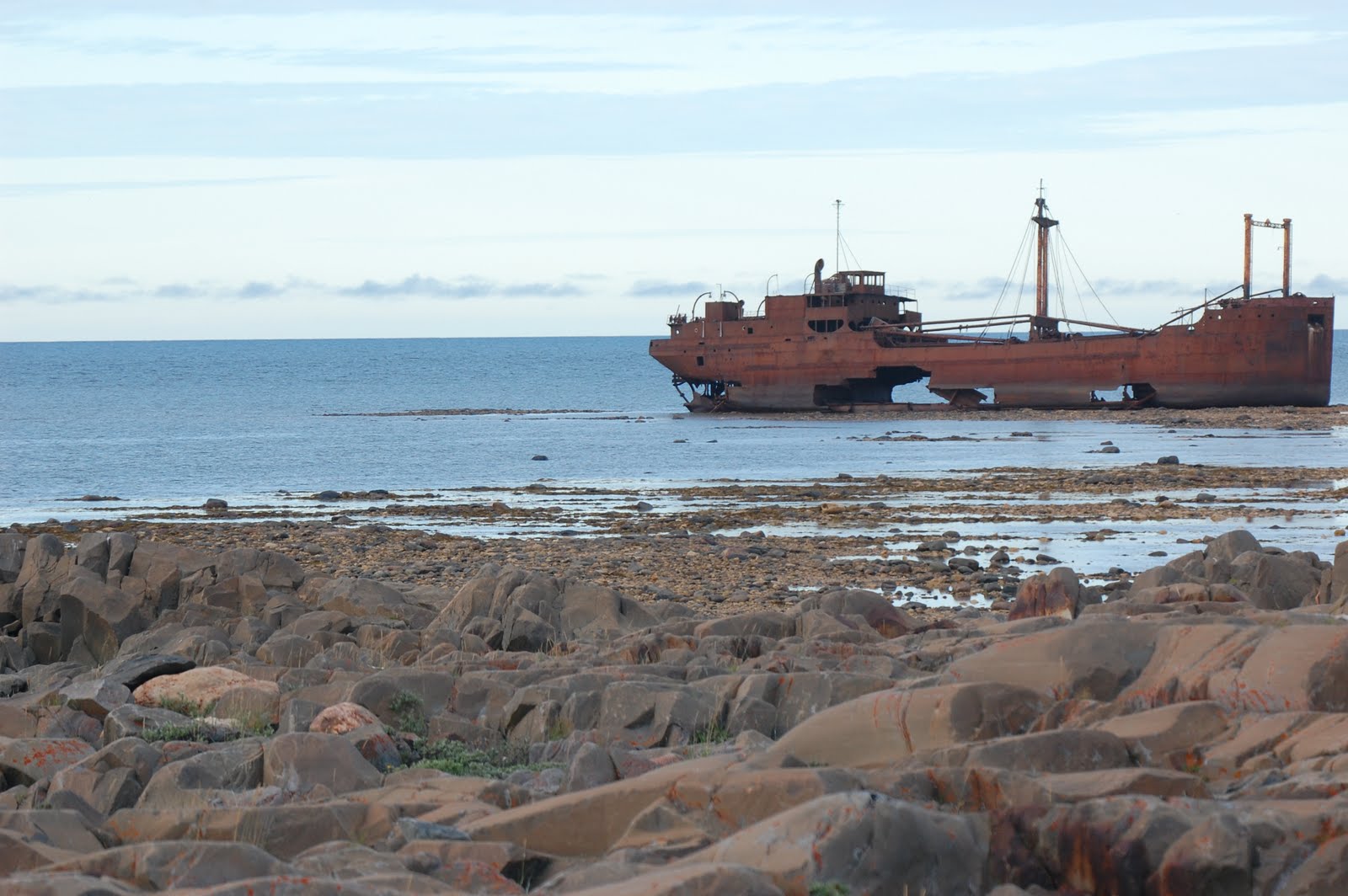
Tonight's adventure, walking out to the Ithaca at lowtide.

Our fantastic bear guard, Krista, taking it very seriously! Thanks!

The Ithaca


This is Caleigh and Krista: "I wonder what would happen if I
squeezed it..."

It squirts out!

Matt karate chopping the giant kelp (we were walking on what
is normally under water so there was kelp and seaweed and algae
everywhere.)

Ribbon cutting ceremony: attempt number 2

We mad it!

There is a hole in the hull. Hi Celia!


Let's all jump at the same time on a rusting out ship with
holes in the floor. Great idea!

Not what we wanted to see: A polar bear came up on the bluffs
between us, out at the Ithaca, and the trucks. Luckily, it decided
that it wasn't interested in us and wandered away down the beach.
Thanks to Krista, who took charge, we all made it safely back to
the trucks without firing a shot. 

Bright sunsets

And neon pink skies.

Also interviewed the other plover lover, Anne. Thanks for the great interview today!

And found three really cool articles for my research on pigments and their use on the benthic and phytoplankton communities + (unexpectedly but awesomely) a nutrient study combining the pigment analysis! How perfect is that?

Sunday, August 7, 2011

Day 68: Snapshots

Today, I saw two red fox, a vole, a golden eagle, countless small fluttering birds and a wolf (too brief and far away for a picture), within the span of 20 minutes driving down Twin Lakes Road toward West Twin Lake to do the water sampling. I like being the first one in the field, the first to disturb the wildlife and the first to see it.


Today, I found some really bizarre looking algae at Coast Pond. Let's do an ink blot test. What do you see? I see green algae that has made some sort of enclosure to capture escaping gas, probably CO2, but that is just my nerdy side cracking through.


Today, I poked the abdomen of a female spider until the baby spiders crawled off so I could count how many there were for the Godwit team. I think I still have a bit of a fear, irrational but present, of spiders.

Today, I interviewed amphibian ecologist, Ben Cash. The landscape came to life with his words as only a true naturalist has the power to do.

Today, I interviewed a plover lover, Lisa - also my rocket climbing, firefly watching buddy. I wonder if the mismatch hypothesis might actually be a benefit to the species... Anne? I will ask her tomorrow. And I'm going to make you, dear and precious reader, wait a bit longer to even know what that means. Though I will give you a hint to go back to the post Research in Action.

Today, I discovered that I have a select number of days left in Churchill and that I am secretly, almost unconsciously and certainly regretfully counting them down. I am making a conscious effort to instead keep counting up.

Today, I only wish to give you a few snapshots, snacks of the stories that each hour here accumulates.

Tuesday, July 26, 2011

Day 56: Science Media

There was definitely an overwhelming theme to today's work - Media. More specifically, media and science.

A lot of the researchers are leaving at the start of August, which gives me less than a week to get some of the interviews conducted for my podcast, Avioyok. The goal of my podcast is to translate specialist scientific knowledge that each of the researchers conducting their studies at CNSC have into something that the public can understand. As my ecology professor said, referring to studying for exams, you should know each topic well enough to be able to fully explain it to your grandmother in one sentence. I don't mean give the basics of the topic, but to really understand the meaning behind the concepts that the technical words for the concepts aren't needed. I'm trying to get the complex research down to the one sentence that will eloquently explain the entire project. I'm trying to do this while still having fun with the interviews, making the researchers I'm interviewing feel comfortable, make it a learning experience for the people I'm interviewing (since they are students that may never have had a real interview before, but if they stay in science, will probably be interviewed many more times).

And I'm also trying to follow a journalistic ethical code that I think is lacking in normal interviews. The main one here is transparency. Too many reporters will interview a scientist just to get the one quote of "toxic cyanobacteria bloom in the lake" without understanding any of the context. They come into the interview with a story already written rather than discovering the real story that the scientist has to offer. In transparency, I want to make sure my intentions are stated up front. This means that I give the person I will be interviewing a letter that describes the exact nature of my project, gives a sample of questions that may be asked in the interview (before the interview so the researcher has some time to think about it), that the researcher is free to participate or drop out of the project at any time so I won't be able to use his/her voice if he/she decides not to be part of it anymore, and the inclusion of the researcher in the process of the creation of the story, sharing a copy of the transcript of the actual interview, and letting them see/hear the edited piece before I give it to the public so they can get a sense of whether what they said is being used out of context. These are constraints I place on myself to keep me honest and to keep me working towards the real story rather than the story I thought I saw in my head. Of course, it is always risky to allow the person you are interviewing to see the project before the public does, I mean, what if the researcher hates it? But in this situation the transcript can back me up because it is truly what is said, giving me the argument for the story I chose. This is a system that protects both the person being interviewed and the interviewer. This podcast will be my test to see if this philosophy could actually work.

So today was the first day of interviews. I woke up at 5:30 to hop on a bike and get out to the field by 6 AM with yellow warbler researcher, Vanya. I had my mic hooked up to my backpack and just kept asking Vanya questions as we walked and biked from nest site to nest site. It was more of a continuous stream of questions that I was simply curious about, rather than an interview. I'm glad he put up with me!
Yellow Warbler chick!

A young arctic fox sat right in front of us, eating possibly one of the yellow warbler chicks, and then ran right up to us, just a few feet away as though we weren't even there, until it lolloped away across the tundra!

I followed up the field interview with an indoor interview. I had to do this just to make sure that I actually had some good audio data. Recording anything outdoors, even if it isn't windy as it wasn't today - unusual in Churchill - is always a huge risk in quality. By the time I was done, I had a solid 3 hours of audio from Vanya which I will need to edit down to something closer to 20 minutes! That task is daunting!

I took a break from my own interviews after the morning only to find out that there was a production crew at the Centre to interview LeeAnn and the science staff to learn about the work they do. I was going out with Jessica to help her with her lake samples in the afternoon and this production crew was going to come out with us as well! I knew I wasn't going to be interviewed myself as the field assistant, but I also knew that even if they are using Jessica's stuff as background footage, they would probably want to know what Jessica's research is. So I chatted with Jessica to help her develop the short explanation of her project - that one sentence, 10 second thing. From experience, I have found that if you let the person interviewing control the messages of the interview, the real story will be lost. As the scientist being interviewed, the best defense against this is to develop that one message that you can share, so the reporter can only use this message without being able to cut it short or misunderstand it. You have to direct the interview to the story you have, not the other way around. So when we were out in the field doing the sampling, of course, they did ask Jessica the question - what are you studying. I'm glad we talked about it because she did so well explaining the project!

That was the afternoon, which left the evening open for two more interviews with two members of the Godwit crew, Andy and Madi who leave on Thursday! Back to back 1 hour interviews! It was a more formal interview style in a classroom where I asked similar questions to both of them. It was really interesting to hear how the two of them responded completely differently to the same questions, same facts, but a slightly different style and take on the events. I still have Hope and Hannah to interview before they leave next week to complete the crew that are still up here. I also want to interview the grad student who hired the crew, Nate, but that will probably wait till the fall and be a phone interview.

I'm so glad to have finally done some interviews before people left for the summer. I was getting a bit nervous that I wouldn't actually have any audio from this summer, but I suddenly have 5 hours worth! And having done the interviews, I'm starting to think that I really can pull this off!

Tuesday, July 19, 2011

Day 49: Research in Action

Today was the BIG SPIKE! So we spiked at 8:00 and sampled, then filtered, then sampled... then filtered... then sampled... 3 times! It takes a while to get this done. And as the day went on, it got colder and wetter, which was... great! Thanks to Ema and Jessica for the great help today! We weren't able to finish the filtering because we decided to go on the Research in Action tour instead. So filter tomorrow, then another sample and another filter... deja vu? Oui!

I broke out the audio recorder and the mic that LeeAnn lent me to take with me on the Research in Action tour which is a tour that picks people up from town and drives them to some of the sites that the researchers are working at where the researchers present. We had a great turn out of around 50 to 60 people would be my estimate! The recordings turned out pretty well, but you will have to wait for the podcast for that! 

This is Ann's talk (in black on the left). She is studying
semipalmated plovers and the mismatch hypothesis. Basically,
this means that the insects, which the plovers eat, are hatching
earlier because the temperatures are higher (climate change)
earlier. So traditionally, the plovers, and other shorebirds,
timed their migration, nesting and mostly the timing of chick
hatching occurs at the same time as the peak of the insects so
there is enough food for the chicks! With climate change, and
the insects hatching earlier, the hypothesis is that the chick hatching
time will not change as quickly as the peak insect time. Bad news
for the plovers. Ann is catching the chicks and the insects so
she can see if this is in fact true!

This is Hannah's talk (in blue on the right). She is the field
team leader for Nate's project studying Hudsonian godwits
and whimbrels. These are both shorebirds, but not much is known
about them. Specifically, they don't know how they migrate,
or how they nest, or how the chicks grow, but they are pretty
amazing birds - migrating from Churchill to the lower tip
of South America, male and female share of responsibilities of
chick rearing , the dramatic physiological changes to prepare for
migration and then after the migration. So most of the work
is trying to locate the nests and then capturing the birds
to put a data logger and tags on them and to get weight and length
measurements and blood samples for DNA and disease detection.
Here, Hannah is modeling how a bird trap works with a volunteer.
The trap snaps closed when you pull the fishing line after the
bird wanders back to its nest. It doesn't hurt the bird.

This is Celia (in pink/purple)! She is
holding a zooplankton net to sample the
lake for zooplankton (found anywhere in
Churchill, if there is a lake that doesn't have
zooplankton, tell Celia... she will be super
excited)! She talked about the importance of
zooplankton in the food chain as a connection
for nutrients and energy between algae and fish.
She also talked about how there are 7-8 species
in each pond and that the community can vary
greatly even between lakes right next to each
other! The communities also vary because
the environmental changes can be severe
because the volume of water is so little.
Specifically, she is looking at how different
communities that she gathers from various lakes
 can establish under different nutrient and
 salinity conditions. She is also interested in
seeing how zooplankton can establish between
lakes - how do they get from lake to lake.
So she has windsocks set up between lakes to
try and capture these resting eggs that the zooplankton
lay to survive winter and harsh conditions
(they can survive for decades in the sediment and
can actually be hatched after 70 years! This
hatching is called resurrection ecology!)
The theory is that the resting eggs are being blown
by the wind between ponds. They could also be
transported by animals or their feces!

This is Vanya (with the yogurt container around his neck!).
He is studying yellow warblers (little droplets of sunshine!)
and is looking at geographic variation of their nest morphology.
So he is holding two different nests in his hands here. One is
a nest made in Churchill, and the other in southern Ontario. The
fluffier, bigger one is from Churchill, the shallower, more woody
one is from Ontario. And he is interested in why the same species
makes such a different type of nest depending on location.
One thing he did find was that it takes 1500 trips for the
females in Churcihll to make the nests and only 500 trips for the
Ontario females! There must be some advantage!
Does it effect the chick growth? Is it warmer or cooler for the climate?
Will it hold more water or less? Or is it even an ancestral quality
that reflects the adaptations to the little ice age? Or maybe
it's just the time investment difference because southern birds
get predated more often and have to rebuild their nests many
times over the nesting period whereas the Churchill ones will
usually build it only once or twice? Vanya thinks this one since
the temperature, the moisture, and chick survival don't seem to be
different. Another thing, Vanya goes around and switches the
nice fluffy Churchill nests with Ontario nests and vice versa down
south - moving them from mansions to shacks to experimentally
manipulate the nests and see how all these variables are
effected. I feel sorry for the ones that get the shacks, but from
the research, it doesn't seem to matter all that much... 

Saturday, July 16, 2011

Day 46: Moments

How do you define a moment?


Maybe a moment is just a small piece of time that can last a millisecond or a minute that we assign some sort of significance to and invest the memory towards. I have listed many moments of my life up here in Churchill, small snapshots of the experiments I've been helping to run, and the work others are doing up here. Maybe a moment is the thing we don't notice while it is happening, but in retrospect becomes the most important image, sound, emotion of the day?

One of today's moments: A giant orange moonrise opposite of the neon sunset while driving home (that was the first time I've called CNSC home...) after bowling.

Another moment: An arctic hare named Harvey the Hare was sitting across the parking lot so I knelt to take a picture. As I'm staring through the lens at this hare the size of a small dog, it bolts towards me! I didn't think it would stop, that it was going to barrel into me!

He stopped just a few feet in front of me.
Little bit of a demon hare with the flash.

Another moment: the event of bowling of which I didn't take any pictures, so you may have to wait a few days to see the amazing t-shirts I designed! The actual moments from this evening are the various dance breaks, the one strike I managed to make, and the posing with the science crew!

I would like opinions on the next idea. I started to work on the form of the podcast today and decided I wanted to come up with a name. This is what I think would work: Avioyok which is Inuit meaning "buzzing in ears." "You're listening to, listening, listening to, Av, Avioyok, Avioyok? Avi.. Avioyok, buzz, Avioyok, buzzing, buzzing in ears, buzzing in ears from Churchill, Churchill, Manitoba." Spliced together from a whole bunch of different people saying it, overlapping. If you have ever heard a Radiolab episode (this post is Radiolab heavy) they have a really cool title sequence that I want to emulate while being able to define the word. Any thoughts?

More Moments, these are defined by symmetry (the bonus track for making it this far in my blog post!):


Wednesday, June 8, 2011

Day 8: Causing trouble


Today's been a really lazy day (my day off!), with reading and listening to music, but I got some general reading done for the podcast. The interview below is really good and should help me with the interviewing portion of the podcasts. I still need to create a proper structure, but I'll save that for a day I feel more productive! Below is one of the best answers:
The Tech: "Finally, can you talk about your interviewing techniques, and how you deal with these scientists?"
Horgan: "If they’ve written books I try to read them. I’ll call their office and say I want to talk to them, and ask for suggestions for reading. Maybe they’ll send me papers, or refer me to papers or books. I also try to call people who have worked with them or in the same field or know them in some way and say, “What questions should I ask this guy to put him on the spot?” or, “Can you tell me a little bit about his background so I get a sense of where he or she is coming from before I meet them.” I try to act awestruck and very respectful and admiring to put them at their ease so they say things that they really regret later."

I love the last line! So devious.


Now for the causing trouble adventure: I got up late so I missed the greasy breakfast. Which is probably a good thing since I've been eating way too much lately. It's just so easy to eat when I don't have to cook it! So I made toast with peanut butter and banana. Well, I tried to make toast. I didn't notice that the toaster was set to really dark. So... I burned it! Not badly! It was still eatable, but it did set off the fire alarm about a minute after I took the toast out. So the fire alarm went off, and people started running everywhere, and the rumour got around that I burnt the toast. "At least I know what the alarm sounds like in the new building," said the CNSC director... great... I guess I'm good at causing trouble.

Tuesday, June 7, 2011

Day 7: Run! (but not from a polar bear!)

On June 15th and 16th, I’m going to be flying! In a chopper! I’ve never flown in a chopper before! Unfortunately, this opportunity has become available to me because the grad student can’t come up for this field trip. Sorry, Nicole! I’ll dedicate my first ride in a helicopter to you!

As cool as this is, the problem with the scenario is that my experiment is planned to run during these days! That means I have to have everything in place for the experiment before I go up, especially since that will be a hectic couple of days with the massive amount of filtering that accompanies Lauren and Nicole’s Wapusk samples. I was up here last year as a field assistant, which mostly meant filtering and carrying cartons of lake water for them. (Wapusk in a national park along the coast east of CNSC.)

So I spent today getting everything in place for my experiment so it can run smoothly in parallel with the chopper! I wrote out the protocols so I have all the steps worked out before I go out to get the samples and come back with nowhere to put them. It will also allow the research staff to do some of the filtering for me when I can’t do it myself. One of the problems I came across was finding a way to keep my lake water filled containers from falling over in the kiddy pool that they will be incubating in. After trying to make a purely string grid and discovering that I had nothing to attach it to, and then thinking about making a frame I could place into the pool (thanks Krista and Jolene for bouncing ideas around with me) and finally coming up with this…!

Three dowel rods across the pool with the containers tied to the dowels with twine!
I "borrowed two broom stick handles for tow of the dowels and need to find just one
more to make this work! I will prototype soon (see, I paid attention in INTEG 121!),
but I'm pretty sure this will work!

The evening also consisted of my first run in a couple months and it was 8km! It was a whole new experience to run with someone else, and more so to run with an annoying bear monitor with a shotgun on his back! Well, I’m not sure if the shotgun was for bear monitoring or for motivation to run faster. Steve did make it feel like boot camp and I wanted to knock him off of his bike a couple of times!

Only in Churchill do you see a bunch of runners going out with a biker
with a shotgun slung over his shoulder!
It was about 2C and windy. But at least I got out!
The buildings in the background are CNSC.
I also discovered an online course sponsored by the World Federation in Science Journalism that teaches how to be a good science journalist. I read through the first lesson and did the assignments. I think this will really help me develop a better understanding of how to report science. It seems a bit more tailored to freelance journalists, but the basic concepts of article construction and interviewing will certainly relate to what I propose to do with my work. Podcasting to start soon!

Sunday, April 24, 2011

Getting Excited!

Me at the mouth of the Churchill River last year. I can't wait to go back!

With my last exam finished and the last assignment handed in, I'm starting to get really excited for the summer! I'm starting out in Waterloo, ON, then will be in Churchill, Manitoba for 2.5 months!

So for the next month, I will be planning out my experiment that I will be conducting up north and getting ready to spend the summer there.

So much to do:
  • Take a First Aid Course
  • Get my PAL - Rifle license
  • Plan out the experiment
    • Research everything related to the topic
    • Narrow down the research question
    • Figure out the methods
    • Find out that the methods don't work according to the literature
    • Research some more
    • Figure out new methods
    • Order materials
    • Run a trial experiment to see how it all works
    • Find out it doesn't work
    • Go back to beginning and try to apply what I learned the first time through
    • Frantically come up with something to bring with me to Churchill
    • Continue adjusting until it seems to be working
    • Make it work
    • Go to Churchill and run the experiment
    • Cross fingers!
  • PALS (Paleolimnology Conference) to present Churchill work from last summer
    • Add new data
    • Re-analyze data
    • Discover that the data is saying something completely different than I thought it had been saying
    • Slave over powerpoint
    • Travel to Montreal
    • Present (woohoo!)
    • Cross fingers that no one will ask a hard question!
  • Prepare the podcast! I'm in Knowledge Integration at UW, which means I get to do a really cool thesis! I've decided to make a podcast about everything I'm doing in Churchill!
    • Find a supervisor
    • Find money/grant to buy or rent a good mic and recorder
    • Figure out how to interview people
    • Figure out how to make a podcast
    • Get a friend to record some cool music
    • And in a simplified version... Be ready to pump out podcasts every week as soon as I get to Churchill! (Yea, I'm optimistic! Or naive!)
  • Prepare to go to Churchill
    • What to pack?!? Is it winter or summer or...?
    • Forget the most essential thing to bring, which is... which is... I can't remember...
    • Throw a Polar Bear themed good-bye party