The title today is "missing it" for several reasons.
Number 1:
Today was my day off, but it was too son in my opinion with the addition of just getting all the data back for the pool experiment (all of those water samples were analyzed!). So instead of taking a day off, I spent the day relearning stats and SPSS, and missing the right steps or the right arrangement of data to do the analyses. It's been a long day working through ANOVAs and the assumptions that are linked with it. At least I got to sit in the lounge to the Aurora Dome, a plastic bubble on top of the building that lets you star gaze and watch the aurora when it is 60 below outside, so it was a great view and warmer than my desk in the lab. Still working on the data, but I think I need to call it a night.
Number 2:
Today, four polar bears were sighted... and I missed them all! Three of the bears were found at the coast, lounging in the rocks, looking like rocks, and easily avoidable. One of them was in the fen, which is inland and an unusual place to spot them. 7 of the birders were out in the fen, searching for nests when they spotted the bear about a kilometer off, which is pretty close to see a bear, especially when they were away from the truck. They double-timed it back to the truck while another researcher was driving out for her work in the fen. She was almost there when she heard the chatter that there was a polar bear ahead, and decided to keep going in case she could get the birders in her truck if she was closer than theirs was. She rounded the bend, startling the bear out of a group of willows! It stood there some 10-15 feet away from her truck! But it was the distraction that the birders needed to get safely in their truck. They had good communication, fired some cracker shots at the bear to scare it away, then rode back to CNSC to call it a day - leaving everything, including a laptop behind. Fortunately, no one was hurt, except possibly the ego of one birder who fell and wedged fen mud up the barrel of his shotgun. Scary, but handled well with everyone, including the bear, safe.
Number 3:
One thing I did not miss out on was the firearms safety training, which I passed! I now have a PAL (as soon as the paper work gets processed, which may be a while yet, but close enough)! So... which gun should I buy? The fun ones to take to the firing range are the 22 gauge rim-action since they are the cheapest and other than for polar bear protection, and since I don't hunt, something fun to shoot at a range would be what I'm looking for. Also, I've found out that you can go shooting without a PAL as long as the person you're going with has one. That's not bad at all!
Number 4:
I'm getting a little homesick and missing everyone. This is the longest I've ever been away from home, and I'm not too bad, I just have to make sure to keep busy.
Number 5:
I don't know if it's because I've been here longer now, or if it is something about the new building, but the social dynamics are falling apart. In the old building, there were hangout spots where you could easily find anyone else and see if anyone wants to watch a movie, go for a bike ride, play cards, play pool or just hang out. Now, if you aren't already part of the group - most of the other researchers are here with a group - then you don't know what anyone else is up to. So I don't know what anyone else is up to, even when I sit in the cafeteria or A/V lounge, no one else is around! I only see them at meal times and even then it's a bit rare since a lot of them are in the field for lunch, and I'm running late in the morning or evening so I miss everyone then as well.
Friday, June 24, 2011


Thursday, June 23, 2011
Day 23: Question Assumptions
The traditional evolutionary example is the story of the peppered moth. Here's how the original goes, as I have heard in numerous ecology and evolution courses and accepted as a really good example:
We are looking at England and we are looking at these small moths that are predated on by birds. So the story goes that before the industrial revolution in England the majority of peppered moths were this molted white variety with much less being the darker variety. As the theory goes, the lighter peppered moths could hide more easily on the light coloured lichen that covered the bark of the trees. When the factories began to open with the industrial revolution, the soot killed the lichen that covered the trees, making the trees appear darker. The theory goes that the moth population began to have more of the dark variety, which now had the advantage to blending into the tree trunks to hide. If the moth can hide, it won't get eaten and will have more offspring, passing that trait on to the next generation.
This is a great example of natural selection and is in every intro genetics, evolution, and ecology textbook that I can remember reading. It's simple. The conclusions are obvious. To pass on genes, you have to survive. To survive, you can't be eaten. To not be eaten, you can camouflage with your surroundings! Great!
So what's the problem? There are assumptions that are questionable. The first is a misunderstanding of the behavioural ecology of the moths. It turns out that some studies showed that the moths are rarely found on tree trunks. The second is a human bias. Humans use sight as a primary sense, so the researchers immediately thought of camouflage, something that is important to us. Birds, the predators of these moths, can sense other spectrums of light, such as UV, in which both varieties of moths are equally detectable, so blending in for our visual spectrum is also meaningless. However, predation studies do seem to indicate that a predator can find and eat more of the darker form in unpolluted areas and more of the white form in the polluted areas. The scientific debate was raised by Jerry Coyne as he critically questioned the original Kettlewell experiments.
I'm not here to say who is right, since science is never decided that way, but is decided through exploration of the scientific questions. I'm just curious why these assumptions took 50 years to be truly questioned. There were studies in the mean time that explored the questions, but not in such a fundamental form. How much of science is based on a couple unknown assumptions? And how easily these assumptions can travel throughout a field as hundreds of papers begin to cite a big study that they build off of, and other papers cite those papers and so on and so on, except there may be a big glaring flaw in that original paper that no one sees, yet everyone builds on top of.
So how can we avoid this? I'm always told to question my assumptions, but it is much harder than it sounds, yet it seems so easy and obvious to question someone else's assumptions, to some extent. For example, in paleolimnology, we identify different species of algae or invertebrates in the sediment layers, sometimes thousands of years back. We know what the optima ranges are for various factors that allow them to survive in the present day, such as temperature, pH, salinity, etc., but how do we know that these are the same optima as that species had hundreds of years ago? I still don't understand this. But for something even closer to me, such as the experiment I designed in the kiddy pool, what am I missing? I know I'm missing something, but what is it? Now that I have some of the results back, I'm wondering if the nutrient availability in the water is temperature dependent, not necessarily even biological, but due to physical attributes of the nutrients, of the sediment? Not letting the system settle long enough to reestablish the algal population in the new containers? Why the spikes weren't noticed in the sampling right away - was it a sampling error, or does it take a while for the nutrients to diffuse in the water? And that's just a few things that I was able to notice, what haven't I noticed?
I know one way to solve the question assumptions problem is to tell other people about the idea and the project to get new perspectives. This also seems like such a simple, obvious step, yet I never really do it. I'm actually irrationally afraid that someone will find a flaw in my experiment that I didn't see, making my work completely useless and there goes my experiment. I know that from failure in science, you can always learn something, you can even learn a lot of really interesting things from failures. But... I don't want to fail! It's opening myself and my project up to criticisms that I'm afraid to take, but it's probably better to do so now than to finish the experiment and have so many bad assumptions that the results are truly meaningless.
I am in a good situation to have gone through the first stage of the experiment with the initial plan of using the first experiment as a trial for the second experiment, allowing me to change things as needed! Always prototype, that's another tenet of design, as is to get feedback from people with no detailed knowledge of the experiment/project. Writing up the methods to be critiqued by family and friends may be my task tomorrow, just to see what I've missed!
We are looking at England and we are looking at these small moths that are predated on by birds. So the story goes that before the industrial revolution in England the majority of peppered moths were this molted white variety with much less being the darker variety. As the theory goes, the lighter peppered moths could hide more easily on the light coloured lichen that covered the bark of the trees. When the factories began to open with the industrial revolution, the soot killed the lichen that covered the trees, making the trees appear darker. The theory goes that the moth population began to have more of the dark variety, which now had the advantage to blending into the tree trunks to hide. If the moth can hide, it won't get eaten and will have more offspring, passing that trait on to the next generation.
This is a great example of natural selection and is in every intro genetics, evolution, and ecology textbook that I can remember reading. It's simple. The conclusions are obvious. To pass on genes, you have to survive. To survive, you can't be eaten. To not be eaten, you can camouflage with your surroundings! Great!
 |
| An illustrated picture of peppered moths from http://www.truthinscience.org.uk/site/content/view/127/65/ |
So what's the problem? There are assumptions that are questionable. The first is a misunderstanding of the behavioural ecology of the moths. It turns out that some studies showed that the moths are rarely found on tree trunks. The second is a human bias. Humans use sight as a primary sense, so the researchers immediately thought of camouflage, something that is important to us. Birds, the predators of these moths, can sense other spectrums of light, such as UV, in which both varieties of moths are equally detectable, so blending in for our visual spectrum is also meaningless. However, predation studies do seem to indicate that a predator can find and eat more of the darker form in unpolluted areas and more of the white form in the polluted areas. The scientific debate was raised by Jerry Coyne as he critically questioned the original Kettlewell experiments.
I'm not here to say who is right, since science is never decided that way, but is decided through exploration of the scientific questions. I'm just curious why these assumptions took 50 years to be truly questioned. There were studies in the mean time that explored the questions, but not in such a fundamental form. How much of science is based on a couple unknown assumptions? And how easily these assumptions can travel throughout a field as hundreds of papers begin to cite a big study that they build off of, and other papers cite those papers and so on and so on, except there may be a big glaring flaw in that original paper that no one sees, yet everyone builds on top of.
So how can we avoid this? I'm always told to question my assumptions, but it is much harder than it sounds, yet it seems so easy and obvious to question someone else's assumptions, to some extent. For example, in paleolimnology, we identify different species of algae or invertebrates in the sediment layers, sometimes thousands of years back. We know what the optima ranges are for various factors that allow them to survive in the present day, such as temperature, pH, salinity, etc., but how do we know that these are the same optima as that species had hundreds of years ago? I still don't understand this. But for something even closer to me, such as the experiment I designed in the kiddy pool, what am I missing? I know I'm missing something, but what is it? Now that I have some of the results back, I'm wondering if the nutrient availability in the water is temperature dependent, not necessarily even biological, but due to physical attributes of the nutrients, of the sediment? Not letting the system settle long enough to reestablish the algal population in the new containers? Why the spikes weren't noticed in the sampling right away - was it a sampling error, or does it take a while for the nutrients to diffuse in the water? And that's just a few things that I was able to notice, what haven't I noticed?
I know one way to solve the question assumptions problem is to tell other people about the idea and the project to get new perspectives. This also seems like such a simple, obvious step, yet I never really do it. I'm actually irrationally afraid that someone will find a flaw in my experiment that I didn't see, making my work completely useless and there goes my experiment. I know that from failure in science, you can always learn something, you can even learn a lot of really interesting things from failures. But... I don't want to fail! It's opening myself and my project up to criticisms that I'm afraid to take, but it's probably better to do so now than to finish the experiment and have so many bad assumptions that the results are truly meaningless.
I am in a good situation to have gone through the first stage of the experiment with the initial plan of using the first experiment as a trial for the second experiment, allowing me to change things as needed! Always prototype, that's another tenet of design, as is to get feedback from people with no detailed knowledge of the experiment/project. Writing up the methods to be critiqued by family and friends may be my task tomorrow, just to see what I've missed!
Wednesday, June 22, 2011
Day 22: Safety off
There was mandatory polar bear safety and firearms training today followed by a trip to the shooting range. So to sum up the polar bear part: always look around and be aware of your surroundings so a bear doesn't sneak up on you or you sneak up on a bear. In the instance that you encounter a bear, remain calm, slowly back up while facing the bear and get everyone in the group together - just forget the gear, get into a vehicle and drive away or into a building. If the bear looks like it is going to charge (head down and swinging, shifting weight on its feet) fire a deterrent, starting with non-lethal. If somehow a mother and cub situation happens, be extremely careful because this is the worst case scenario and the mother will fight to the death. But you do the same thing - keep it cool, slowly back away, use the deterrents making sure the bears will move together to the same escape location where there is no one else they can run into.
Now to the fun stuff!
 |
| The Red Dragon! A 1981 standard of some maker - I'm not good at remembering car brands. It was extremely sketchy though! |
 |
| The firing range with targets set against a sand dune. We shot from 20 paces. |
 |
| This is a picture of the first time I ever shot a gun as the recoil from the 22 gauge pump-action shotgun pushes me back into Kat's hand and pushes the end of the barrel towards the sky. I shot a gun!! Kat said I was so giddy and giggly after every shot. It was awesome! Next I'll be like Cari Byron cutting trees with a minigun Dillon M134D. So much fun! Now all I have to do is learn how to sight down the barrel and not raise the gun in anticipation. |
Last night was summer solstice! We had a Trash Dash to clean up the area of the construction site garbage that was blown into the rocks and trees. Then we were rewarded with a campfire with marshmallows, chips, and, the necessity of every casual science gathering, beer. A great tradition that left me and all my clothes smelling of smoke - which is great since I really don't have that many clothes up here so I have to smell like smoke until I can do laundry again!
 |
| To roast the jumbo marshmallows, a technique was involved. Roast the outer layer over the coals, pull that off leaving a gooey melty mellow which gets roasted again. The best roasters managed 5 layers of roasties. |
 |
| This is around midnight. What isn't seen in this picture is that the sun was still setting behind me, and still setting when I went to bed at 1 pm. |
Tuesday, June 21, 2011
Day 21: Tree Ideas
This post will be very academic and filled with questions since I am trying to figure out how to set up the coring of the trees in the fen between my study lake, Larch, and the lake that feeds the inflow into Larch.
This may just reveal how my mind works as I try to research these questions and how I develop these questions. The first credit goes to the person who commented at the end of my PALS presentation that I could verify the age of the fen leading into Larch by sampling the tree rings.
So here it goes...
I'm interested in figuring out:
- Which species to core: Larch? Black spruce? White spruce?
- Where to core: Within the fen connection? Outside of the fen connection but still close to the study lake? Somewhere else in the region (or just compare to other cores taken in the region?)? We need to be able to determine if the growth rings during the time we are interested is due to the increased moisture (due to hydrological connection) or due to some other regional climatic factor.
- How many to core: How many to be statistically significant?
- How many cores in one tree? Two at about the same height but different angles to see the rings all the way around? One at chest height? What's the difference between base and chest height cores?
- How old are the trees?
- How do I find the oldest tree? Just by height and width of the trunk?
- Do I only core the oldest?
- If the oldest trees are still younger than the connection that we hypothesize occurred around 1960, will they be of any use at all?
- If the oldest trees are a lot older, is there a way to see a signal of increased moisture in the soil such as increased growth? Can I differentiate between increased moisture due to the melting of the snowpack at the beginning of the summer to increased moisture throughout the summer which could indicate the connection between the lakes? I will need to compare to trees that are in dry areas (how do I know that these areas are historically dry?).
- What am I looking for in a core?
- Wide growth rings starting around 1960 in the trees along the fen, but not the trees outside of the fen
- continuous rings (discontinuous rings could indicate disease?)
Paper #1: Girardin et al., 2005 doi: 10.1657/1523-0430(2005)037[0206:RGOTLL]2.0.CO;2
Overview: Using tree cores from spruce and tamarack to determine the effects of the larch sawfly herbivory on the radial growth of tamaracks due to the defoliation of the trees. The study correlates the rings with the epidemic levels of the sawfly that slowed growth in the trees. Growth rings also correlate with the regional climate.
 |
| Larch sawfly |
- "Most variations in radial growth (highs and lows) were adequately predicted, with the exception of the 1940s and 1950s for which the prediction models underestimated the growth reductions in both tamarack and spruces." - where are these sites? Are any of the sites near my lake?
- Less severe larch sawfly outbreaks in hydric site - does that mean that in the same tree and during the same outbreaks as other trees in the region, the damage will be less severe once the hydrological connection is made into Larch?
- Should I use tamaracks if there seems to be a large larch sawfly epidemic right in the time frame I am looking at? Should I use white or black spruce instead? Which one?
- How do I know the growth ring changes are due to regional effects, local effects, bugs and other catastrophes?
- Statistical testing: Tree rings after the fen connection developed for the trees in the fen should differ significantly from the tree rings before the connection, which should be most similar to the tree rings outside of the fen (correcting for regional climate changes).
- "This hypothesis is supported by the fact that the stand least susceptible to sawfly outbreak (LLA5) showed the weakest correlation with the nonhost chronologies and the highest percentage of affected trees in the outbreak analysis (Fig. 6) during the interval 1903–1912." - where is this stand? Would this be a stand that would look similar to the Larch inflow stand?
- "Periodic flooding of bogs was reported to produce growth reduction which, were “indistinguishable” from those caused by larch sawfly defoliation (Nairn et al., 1962; Ives and Nairn, 1966a)." and "Denyer and Riley (1964) reported important dieback and root mortality in tamarack growing in “treed muskeg” due to rising water levels."
- Would this mean that instead of increased growth after 1960, I will actually find a period of supressed growth?
- Would black spruce (which grows better in wet soil) grow better in the fen or first establish itself in the fen when it is produced, outcompeting the tamarack?
- What to try to correlate with?
- Trees outside of the fen
- the larch core data
- climate - regional temp during different months, precip during different months - how important is this for my study?
Paper #2: Tardif et al. 2008, Tree rings, δ13C and climate in Picea glauca growing near Churchill, subarctic Manitoba, Canada
- "The climate signal contained in both ring-width and the δ13C residual chronologies suggests that warm early summers were conducive to larger rings whereas the δ13C best reflects the overall growing season temperature. Precipitation, relative humidity and/or drought index have little to no association with either chronology."
- So this is looking at regional climate, not small scale locations and impacts, maybe that's why there is no correlation to the broad data - maybe the resolution of δ13C isn't strong enough
- "Compressional growth rings formed as wide, lignified bands on the downslope side of the stem as a mechanism for restoring vertical growth, and the number of compression rings laid down indicated the number of years of leaning by each tree."
- really interesting - an indication of permafrost thaw due to slump and figuring out when that slump began but not sure if it really helps
- The writing of this study seems more like a personal write-up rather than a journal article. I'll have to remember that when I write mine
Paper #4: Ise and Moorcroft 2008, Quantifying local factors in medium-frequency trends of tree ring records: Case study in Canadian boreal forests
- "In a Canadian continental boreal region, we compared synchronicity of medium-frequency tree ring patterns of open- and closed-canopy black spruce (Picea mariana (Mill.) B.S.P.) stands, and considered underlying mechanisms of spatial synchronicity."
- Specifically looking for ecological interactions between individual trees that limit that tree's growth to determine stand history rather than the regional averages (where this sort of detailed information is filtered out)
- I'm looking for this type of resolution! Not on the regional scale
- So this study is looking at techniques to enhance the local "gap-scale" (the gap-scale refers to the space around a tree when the neighboring tree dies - there is more detail about the crown expansion and growth rate of the trees, but I don't think I need to get into that here) effects - through stratified sampling design which maybe I could implement.
- "Medium-frequency signals were extracted with an index derived from exponentially weighted moving average (EWMA) in a continuous time series."
- "Then, by using this index, local effects were quantified with an analysis of synchronicity in patterns."
- "Our assumptions were that regional factors such as climatic variations are relatively homogeneous within the given stand, whereas local factors such as stochastic disturbance and competition occur in a less synchronous fashion in a mature stand (Tessier et al., 1997)."
Monday, June 20, 2011
Day 20: Tree stories
This morning, I was attacked by Bonapartes. I was sampling the Alpine and getting temperature readings when a sandpiper, probably a yellow-leg, started sending out this piercing alarm call while perched on top of a spruce. I assume it had a nest nearby. I kept sampling, not really thinking more than, yea there's a nest somewhere. But, within a minute, another one shows up, bringing with it three Bonaparte's gulls that began dive bombing my head! I held up my yellow field notebook so they would target that instead of my head, and it worked a bit, but they still got within feet of me before finally turning away. I made a run for it, forgetting one of my sampling couplers (a resister that can measure temperature based on the differences in resistance in the metal) so I stealthily snuck back out. As soon as I hear the alarm calls again, I booked it out of there! Those dive bombs were terrifying! (Though I was smiling the whole time!)
 |
| Common Butterwort - this plant secretes a mucilage that looks like water and attracts animals that are searching for water. Once the animal lands on the leaf with what it thinks is water, it gets trapped by the mucilage! The plant then secretes enzymes to digest the trapped insects until only an exoskeleton is left... freaky! You can see the trapped insects on this butterwort! |
 |
| Lapland Rosebay Rhododendron lapponicum which will bud into a beautiful purple flower that will cover the tundra floor, painting the ground purple instead of the current browns and dull greens. |
 |
| Pink Bog Rosemary with light green lichen in the centre and yellow cranberry on the left. |
 |
| Tundra close up |
 |
| Pete, the EarthWatch guy, explaining how to take a tree core! Well, in this photo he is explaining why one side of the tree has been stripped of branches on the North West. This is because the ice and snow is blown from the north-west in the winter and abrades this side of the tree until it can finally grow tall enough to be above the ice crystal bombardment. Also, how to tell white spruce from black spruce. Look at the latest growth (on the ends of the stems) and fold back the needles. If the area between the needles is woody and scaly, it is a white spruce. If it is fuzzy, it is a black spruce. This one is a white spruce. |
 |
| They are actually coring this tree. You do this at the base of the tree and again at a standardized chest height (of 1.3 m in Canada, and 1.4 m in the US). I don't know why these locations are chosen. The blue tree corer has a screw inside that carves the hole into the tree and then extracts the core intact. |
 |
| That thin straw-like thing is the tree core! So important things to look for. The core has bark on either side (so you get the full core) and that the core goes through the pith which is the very centre of the tree. If it doesn't go through this, then the core won't have all the rings on it and can't be counted. And because one of the reasons we core the tree is to find out the age (among other things such as climatic conditions, soil conditions, blights, etc.) so you need to have the rings! |
 |
| The hole after the coring. It's a very small hole so it will not interfere with the flow of nutrients up the tree. It can introduce bacteria into the tree since the main defense of plants is the bark. However, the tree also secretes resin within a day of the coring which fills the hole and provides protection. |
I also need to measure the height of the tree (breaking out that forgotten trig), the width of the trunk where I cored the tree, and the gps location and elevation. Measuring the elevation may also help to determine the flow between the lakes where I was unable to visually see the flow.
Sunday, June 19, 2011
Day 19: Climb
I finally got my climbing fix. Along the shores of Hudson Bay, there is a short bluff with large rocks. When I stood at the bottom, next to the salt water of the Bay, the bluff rose a few feet above my head. At a ninety degree incline with few obvious holds, the rocks looked perfect for a short scramble.
 |
| Bird Cove along the Bay with the last remnants of snow and ice. The wind is still harsh enough to stain my cheeks red and make me wrap in layers. |
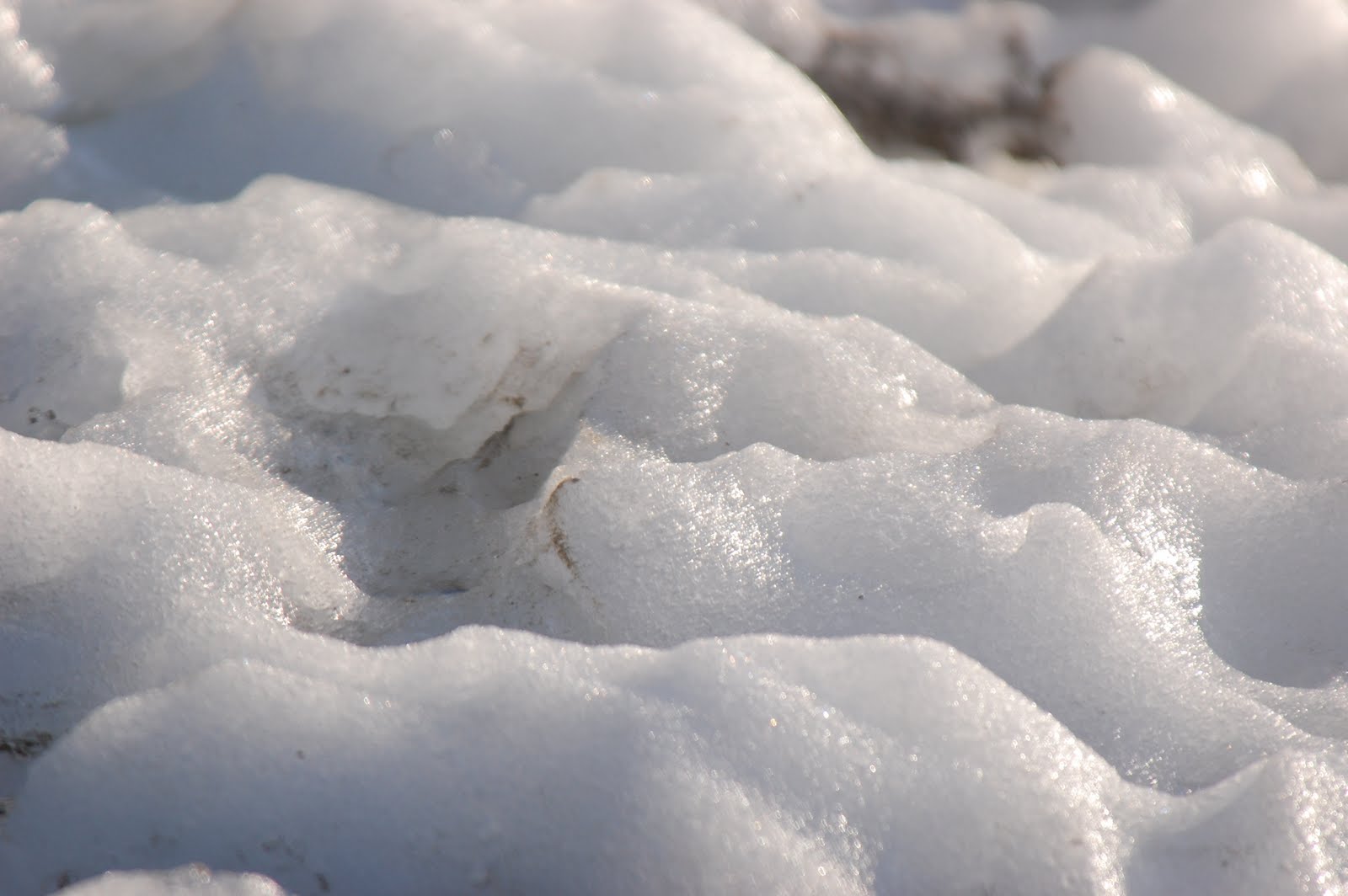 |
| The details of the ice as it is molded by the wind and snow melt. I wonder how long the beauty of the crystals will last. |
 |
| The edge of a bluff in stark relief against a setting sun. |
All is good though and the rest of the day was relatively uneventful - water sampling, filtering, picking people up at the airport for a group called EarthWatch.
Saturday, June 18, 2011
Day 18: Inu
My day off was a trip to the mouth of the Churchill River:
 |
| Two beluga whales or Qilalugaq |
 |
| Harbour Seal playing near shore |
 |
| Common Eiders on an ice float being swept into the bay |
 |
| Raven being attacked by Arctic Tern after predating their nests. |
And also a stop in at the Eskimo Museum:
It is called the Eskimo Museum, but as the invading white people recently learned, "eskimo" is a derogatory term meaning "makers of snowshoes," "speakers of a foreign tongue," and the Ojibwa form of "raw meat eaters" or "one who eats raw."
So the self-designation is a little different. Inuit means "the people" referring to all the indigenous arctic people. Inuk refers to one individual, Inuuk refers to two individuals. Then there is further breakdown of the self-designations depending on location. In Western Canadian Arctic, the singular is Inuvialuk and the plural for the people is Inuvialuit. The root, "Inu" means life!
 |
| Wunderkammer! Everything from a full Qajaq (kayak) to a narwal tusk, a stuffed polar bear to soapstone and antler sculptures. |
The stories that accompany the sculptures are so short and pointed. For example:
Mythical Bird that Helped a Man
This mythical bird was so large and strong that it could carry a man. Once, a man was running away from people trying to kill him. He came to a river that he could not cross but the bird carried him across it and he escaped.
As told by Therese Arnasivik Tabo
Another sculpture I saw was labeled, young polar bear meets young birds for first time. So this is the story I came up with:
 |
| Young Bear: first polar bear I have seen this year, but he doesn't quite count. |
Young Bear that meets Young Bird
The young bear walked away from his mother and met young bird. Young bear had never seen a bird. Young bird had never seen a bear. Young bear sniffed young bird curiously and startled back when young bird ruffled and shook his feathers. Then young bear pawed the soft feathers like he would his brother.
As told by Kaleigh Eichel
Subscribe to:
Posts (Atom)